Why a “CRM That Builds Itself” Actually Matters More Than Another Analytics Toy
Every cross-border operator I know is drowning in the same paradox: the tools that promise to organize your business require more maintenance than the business itself. You pay for a CRM, spend a weekend configuring pipelines, and by Tuesday it’s a digital graveyard of half-imported leads and stale follow-up tasks. Meanwhile, your Amazon PPC manager is exporting CSVs into a spreadsheet that hasn’t been updated since Q3. The problem isn’t that we lack software — it’s that every tool assumes your workflow should adapt to its schema. That’s why Lightfield caught my eye, not because it’s another AI wrapper, but because the underlying thesis — a system that builds its own structure from your data instead of forcing you into a rigid pipeline — is exactly what a seller operating across Shopify, TikTok Shop, and FBA needs. If a CRM can genuinely infer relationships between a customer email, a return request, and a WhatsApp thread without me configuring a single field, that changes the economics of hiring a VA to do data entry. And the technical approach behind it — the same obsession with cost-efficient architecture that makes a free-tier analytics tool viable — is a lesson in how lean your own tooling stack should be.
The launch page I’m referencing is for a product called Lightfield, an “AI-native CRM that builds itself and does work for you.” But the deeper story, and the reason I’m writing 3,000 words about it, is the maker’s other project — Edgemetry — which was posted by the same founder and reveals the engineering mindset behind the CRM. Edgemetry is a web analytics tool that runs on a single Cloudflare Worker and a D1 database, designed to fit entirely inside the free tier. The product itself is a side quest, but the design constraints are the real content. Let me explain why a seller running a $50k/month store should care about a 400-visitor analytics tool.
The Real Problem: Your CRM Is a Part-Time Job
The pitch for Lightfield is seductive: a CRM that “builds itself” and “does work for you.” For anyone who has managed a multi-channel operation, that phrase hits a nerve. The current incumbents — HubSpot, Salesforce, even leaner options like Pipedrive — all require a significant upfront investment in taxonomy. You have to decide what a “deal” means, what stages exist, which fields are mandatory. For a DTC brand selling on Shopify and Amazon Seller Central, that’s a nightmare because your “customer” is fragmented across three different platforms with three different data models. A return on Amazon doesn’t look like a ticket in your helpdesk, and a TikTok comment isn’t a lead.
Lightfield’s premise is that AI can observe your data flows and infer the structure. Instead of you dragging fields onto a form, the system watches how you interact with emails, calls, and notes, then builds the schema it thinks you need. That’s a radical departure from the “configure-then-use” model. The maker, Nitin Hayaran, is the same person behind Edgemetry, and his focus on eliminating friction is consistent. He built Edgemetry because he was annoyed with every option — Google Analytics was overkill, Plausible Cloud was a recurring bill for a site with 400 visitors, and self-hosting meant managing a VPS with Docker. That’s the same frustration a seller feels when they look at a CRM implementation consultant’s quote.
The difference for cross-border sellers is that we don’t have the luxury of ignoring the problem. Our margins are thinner, and our data is messier. A CRM that requires a data engineer to set up is a luxury item, not a tool. Lightfield, at least in its thesis, is trying to be the opposite: a tool that does the setup work itself. The “does work for you” part is the bigger claim — not just storing data, but taking actions. For a seller, that could mean automatically drafting a follow-up email to a customer who abandoned a cart on Shopify, or flagging a supplier who’s been late three times in a row. That’s the promise. Whether it delivers is another question, but the direction is correct.
Why Amazon Sellers Should Care More Than Shopify Ones
Shopify sellers have a relatively clean data model. Orders, customers, and products are all in one place, and apps like Klaviyo handle the email side. Amazon sellers, however, live in a walled garden where data is doled out in daily flat files. Your CRM has to ingest a settlement report, match it to a return, and then update a customer record — all without native API access to the buyer’s email. That’s where an AI-native CRM could actually shine. If it can parse the unstructured notes from your VA and the CSV exports from Seller Central and figure out that “John D. from Ohio who bought the red widget” is the same person as “customer #12345 in your refund log,” that saves hours of manual reconciliation. Shopify sellers have it easier, so they can stick with a dumb pipe. Amazon sellers need a brain.
How Edgemetry’s Architecture Is the Real Lesson
Now, let’s pivot to the technical side, because this is where the cross-border seller can actually borrow something concrete. Edgemetry is not a CRM, but its design philosophy is a masterclass in cost engineering. The problem was simple: how do you get analytics for a side project without paying for a server or dealing with cookie banners? The answer was to run everything on one Cloudflare Worker and one D1 database. The key constraint was the free tier: D1 allows 100,000 row writes a day, and DELETE costs the same as INSERT. If you build a naive events table with nightly cleanup, you burn four writes per pageview and die at 8,000 visits.
Hayaran’s solution was elegant: raw events land in per-hour tables with no indexes, one write per pageview. Those tables are never deleted from; they’re rolled up and then DROPped, because DROP TABLE is DDL and costs nothing. That lands at ~1.2 writes per pageview, roughly 20,000 visits a day inside the free tier. This is the kind of thinking that separates a founder who understands infrastructure from a marketer who just wants a dashboard. For a seller, this translates to your logistics and inventory management. If you’re using a tool that charges per API call or per row, you need to think about your data lifecycle. Are you storing every scan event from ShipStation forever? Are you paying for storage on data you’ll never query again? The Edgemetry approach says: roll it up, drop the raw data, and keep only the insights.
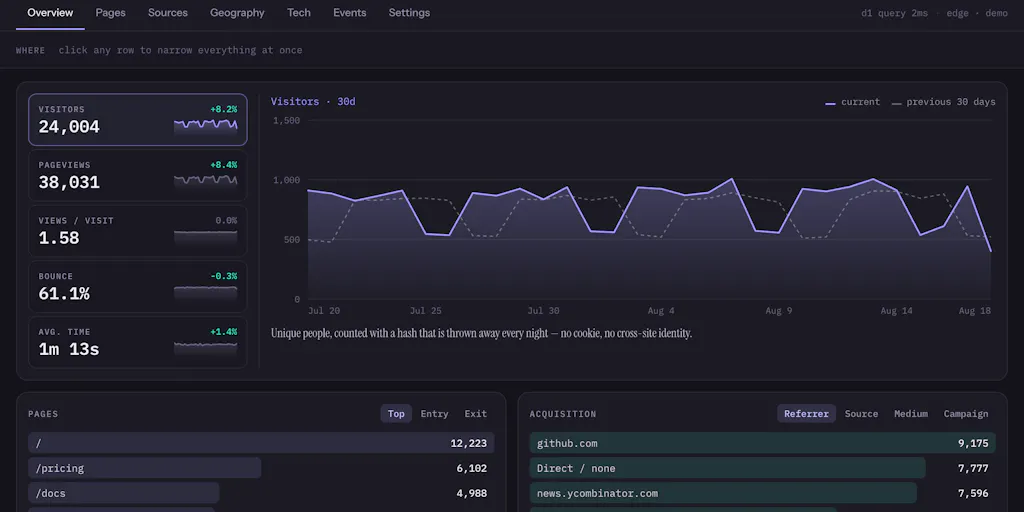
The product itself delivers five metrics with sparklines, period comparison, and stackable filters. Clicking any row narrows every panel at once. It has a choropleth map served from your own Worker, realtime events, custom events, ⌘K search, and support for multiple sites and viewer accounts. Crucially, there is no third-party request from any browser, ever. That last point is gold for anyone operating in the EU or California — no cookie banner, no GDPR headache. The demo is live at https://hayaran.github.io/Edgemetry/ and it’s the real dashboard running on made-up traffic. You don’t even need to sign in.
Where the Math Breaks
Let’s be honest about the limits. Edgemetry is built for low-traffic sites. 20,000 visits a day sounds like a lot until you have a viral TikTok post that sends 100,000 visitors to your landing page. At that point, the free tier math breaks. You’d be forced to upgrade or watch your analytics die. For a serious seller running a Black Friday sale, that’s a non-starter. The same applies to Lightfield — a CRM that “builds itself” is great until it misinterprets a data relationship and you have to manually untangle it. AI is probabilistic, and your customer database is not the place for a 95% confidence interval. If it guesses wrong about which order belongs to which customer, your fulfillment team will ship the wrong product.
There’s also the question of scale for the CRM. Hayaran is a maker, and his focus is on elegant solutions for small-to-medium problems. The analytics tool is designed for a side project. The CRM might have similar ambitions. For a seller doing $1M+ in revenue with a team of 20, you need workflow automation, role-based permissions, and audit logs. Those are not features you bolt on after the fact; they’re core infrastructure. If Lightfield is built on the same “one Worker and one D1 database” philosophy, it will hit a wall fast. The cost model that makes sense for 20,000 pageviews a day is not the same one that handles 20,000 customer records with 50 fields each and a year of interaction history.
What Cross-Border Sellers Can Borrow Right Now
Even if you don’t switch your CRM or your analytics, there are three concrete takeaways from this launch that you can apply this week.
First, audit your data lifecycle. Look at every tool you pay for — Helium 10, Jungle Scout, your ERP, your review management software. Are you storing raw data that you never aggregate? Are you paying for row-level storage on data that should be rolled up into daily summaries? The Edgemetry model of “write once, roll up, drop the raw” is a blueprint for cutting your data costs by 80%. Most SaaS tools charge for storage and API calls. If you can reduce the volume of data you keep, you reduce your bill.
Second, reconsider your consent banner. Edgemetry’s biggest selling point is that it makes no third-party request from any browser. That means no tracking cookies, no consent pop-ups, and no slowdown on your landing page. For a seller running ads to the EU, this is a conversion killer. A cookie banner can reduce your conversion rate by 3-5%. If you can switch to a privacy-friendly analytics tool that doesn’t require consent, you’ll see an immediate lift in sales. Google Analytics is free, but it’s not free — it costs you in lost conversions and potential GDPR fines. The trade-off is worth re-evaluating.
Third, evaluate AI tools by their setup cost, not their features. Lightfield’s pitch is “builds itself,” but the real question is: how much time did you spend configuring it? For any tool you adopt, calculate the “time to first value.” If it takes more than an hour to set up a pipeline, it’s too complex for a lean operation. The best tools for cross-border sellers are the ones that work out of the box. Hayaran built Edgemetry because he was annoyed by the setup of every other option. That annoyance is your signal. If a tool feels like a chore to configure, it’s a bad tool, regardless of what the feature list says.
Where I’m Skeptical — The Judgment Call
Let me be clear about my reservations. The “AI-native CRM” category is crowded with vaporware. Every month, there’s a new tool that claims to “automate your workflows” but fails at the basic task of syncing with your email provider. Lightfield has a compelling founder and a smart engineering approach, but I haven’t seen the product in action. The demo for Edgemetry is public, and it works as advertised. The demo for Lightfield is not. That asymmetry makes me cautious.
The other issue is the “does work for you” claim. In a CRM context, that means sending emails, updating records, and possibly making calls. That’s a high-stakes game. If an AI sends a wrong email to a VIP customer, you’ve lost a relationship. The cost of an error is not just the time to fix it; it’s the trust of your best customers. I’d rather have a CRM that stores data reliably and lets me do the outreach manually than one that tries to be proactive and gets it wrong. The “self-building” part is fine — I’m happy to let AI infer the schema. But the “doing work” part needs to be heavily sandboxed before I let it loose on my customer base.
There’s also the question of lock-in. If Lightfield builds its own schema and you want to export your data to Salesforce or a data warehouse, will you be able to? The Edgemetry approach uses standard SQL on D1, which is portable. But a CRM that “builds itself” might create a proprietary data model that’s hard to extract. That’s a risk. You’re trading setup convenience for future flexibility. For a small seller, that’s a fine trade. For a brand that might get acquired, it’s a dealbreaker.
What I’d Watch / Test Next
Here’s my practical advice for the next seven days, and it doesn’t require you to switch your entire stack.
First, go play with the Edgemetry demo. Click around, apply the stackable filters, and look at the realtime data. This is not a mockup; it’s a live dashboard. Pay attention to the speed. If a free-tier tool on a Cloudflare Worker responds faster than your current analytics, that’s a signal that your infrastructure is bloated. If you like it, deploy it for one low-traffic side project — not your main store — and see how the installation process feels. The “click deploy” promise is worth testing.
Second, if you’re evaluating Lightfield, don’t look at the features. Look at the export options and the permission model. Ask the maker, Nitin Hayaran, directly: “How do I get my data out if I leave?” and “Can I restrict what the AI does to read-only?” If the answer is vague, walk away. The best CRM is the one you can leave without a lawsuit.
Third, do a cost audit of your current analytics stack. If you’re paying for Plausible or a similar service for a site that gets fewer than 10,000 visitors a month, cancel it. Use the free tier of something else or self-host a lightweight script. The money you save is not the point — the point is to force yourself to think about whether every tool in your stack is earning its keep. The same logic applies to your CRM. If you’re paying for HubSpot but only using it to store contacts, downgrade to a free tier and spend the savings on ads.
Finally, watch the comments on the Lightfield Product Hunt page. The maker has promised to answer questions about the D1 cost model and where it breaks. That’s the kind of transparency you want from a vendor. If he’s honest about the limits, that’s a good sign. If he deflects, move on. The cross-border game is won on details, and the people who build tools for the free tier are the ones who understand that every penny counts. Whether Lightfield becomes your CRM or not, the philosophy behind it — build something that fits the constraints, don’t force the constraints to fit your product — is the right one for a seller navigating tariffs, shipping delays, and platform fee hikes.


