Why a Scheduled AI Agent Changes the Game for Cross-Border Operations
For most cross-border sellers, the phrase “AI automation” has come to mean one of two things: a chatbot that half-heartedly answers customer service tickets, or a content generator that produces SEO blog posts nobody reads. We’ve been sold a vision of autonomous operations, but what we actually got was a series of tools that require manual triggering. You still have to wake up, open your dashboard, and tell the machine to go do its job. The real bottleneck in our industry isn’t the quality of the AI — it’s the scheduling. We need systems that run on their own clock, not ours. When a tool like Cronloop AI appears, promising to close that loop by letting agents work on a recurring schedule, it’s worth more than a passing glance. This isn’t about building a flashy website; it’s about whether we can finally offload the relentless, recurring drudgery of e-commerce operations — price monitoring, review analysis, inventory checks — to a machine that never sleeps and never asks for a day off.
The Problem: We’re All Stuck in the Trigger-Action Paradigm
The modern e-commerce operator’s stack is a graveyard of half-used SaaS subscriptions. We sign up for tools that promise to “automate” our workflows, but the automation is often a one-way street. You set a Zapier integration to fire when a new order comes in, or you schedule a report to be emailed to you every Monday. That’s not automation; that’s a slightly more convenient version of doing it yourself. The fundamental issue is that most tools are reactive. They wait for an event — a new sale, a new review, a new message — and then they react to it. The proactive, recurring tasks are left to us.
Consider the daily grind of a typical Amazon FBA brand owner. You need to check your Seller Central dashboard for Buy Box fluctuations, monitor your inventory levels against your reorder point, scan new reviews for potential quality issues, and keep an eye on your competitors’ pricing. That’s four distinct tasks, each requiring a different tool, a different login, and a different mental context. None of them are triggered by a single event; they’re all on a timer. This is where the paradigm breaks. We need software that runs on a schedule, not just in response to a webhook.
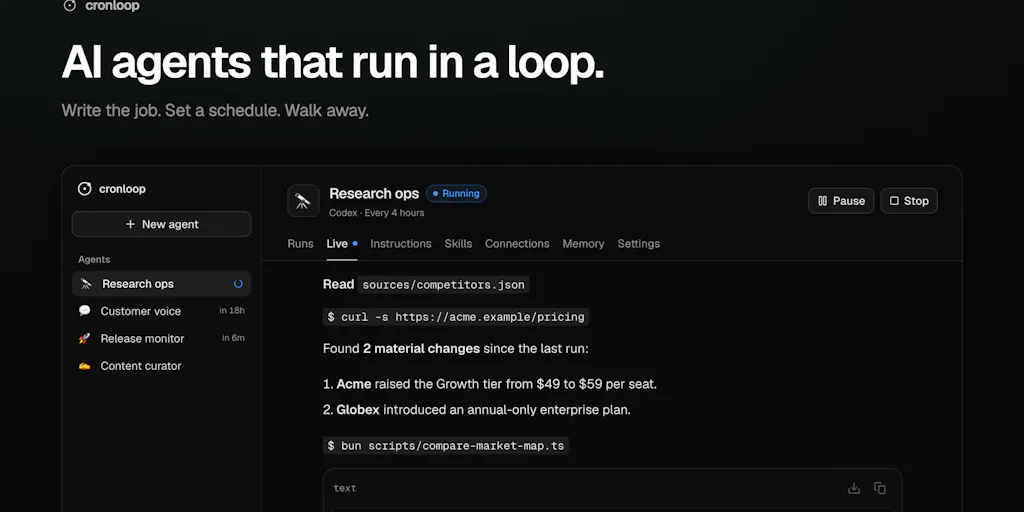
The Cronloop AI approach is deceptively simple: it’s a cron job for your AI agents. You define the schedule, give the agent a mission, connect your tools, and let it run in an isolated sandbox. The maker, Mike Tromba, frames it around his own use cases — curating an events website or autonomously optimizing SEO daily. But strip away the marketing, and the core value proposition is something cross-border sellers have been begging for: a way to turn recurring operational tasks into a set-and-forget loop.
Why This Matters More for Amazon Sellers Than Shopify DTC Brands
Let’s be honest: a Shopify DTC brand with a clean product feed and a solid Klaviyo flow has a different operational burden than an Amazon seller. The DTC operator’s job is mostly about acquisition and creative testing. The Amazon seller’s job is about maintenance. You’re constantly fighting for the Buy Box, managing a fragile inventory forecast, and dealing with a review ecosystem that can sink a product overnight. Amazon is a platform that punishes inaction. If you don’t actively manage your listings, your rankings slip. If you don’t monitor your inbound shipments, you hit stockouts.
For these operators, a scheduled agent isn’t a luxury; it’s a necessity. Imagine an agent that runs every six hours to check your inventory levels across three fulfillment centers, cross-references your sales velocity from the last seven days, and then sends you a push notification when you’re projected to hit a stockout in ten days. That’s not a feature; that’s a relief valve. The ability to connect to tools via MCP, CLI, SDK, or API — as mentioned in the product description — means you could theoretically hook it up to your inventory management system or your repricing tool. It’s about time we stopped treating AI as a chat interface and started treating it as a background worker.
How Cronloop Differs from the Incumbents
There’s a crowded field of AI agent builders out there, and it’s worth drawing the battle lines. On one side, you have platforms like Make and Zapier, which are excellent for deterministic, step-by-step workflows. They’re powerful, but they’re not autonomous. They don’t write their own instructions or adapt to new data. On the other side, you have conversational AI tools like ChatGPT or Claude, which are great for generating content but are stateless. You have to feed them context every time, and they don’t remember what they did in the last run unless you build that memory yourself.
Cronloop sits in a third, less crowded space: the autonomous loop. The key differentiator here is the “durable markdown-based memory system.” This is more significant than it sounds. Most AI tools are amnesiacs. They start fresh every session. Cronloop’s approach allows agents to “self-improve over time” by recording learnings from each run. For a cross-border seller, this is the difference between a bot that checks the same competitor price every day and a bot that learns that competitor X drops prices every Wednesday and adjusts your own pricing strategy proactively.
Another critical distinction is the “bring your own inference” model. The pricing page indicates you can leverage existing Claude Code/Codex subscriptions or bring your own API key. This is a clever move. It means the tool’s cost is decoupled from the inference cost. You’re not paying a hefty markup for the AI brain; you’re paying for the orchestration, the sandboxing, and the scheduling. For a lean e-commerce operation, this makes the economics far more palatable than a platform that charges a premium per token.
Where the Math Breaks
Let’s talk about the cost structure, because that’s where the rubber meets the road. The free tier allows up to three agents, which is a generous way to test the waters. The pro plan, at $25/mo (or $20/mo annual), offers unlimited agents with a 5-minute interval. That’s a compelling price point. But here’s the catch: you’re bringing your own inference. If you’re using a Claude Code subscription, you’re paying for that separately. If you’re using an API key, you’re paying per token. The orchestration cost might be low, but the compute cost could balloon if you have a 5-minute interval agent that’s constantly processing large datasets.
The math only works if you design your loops efficiently. If you have an agent that scrapes 500 competitor listings every 5 minutes, you’re going to burn through API credits fast. The tool is brilliant for high-value, low-frequency tasks — like daily review analysis or weekly inventory forecasting — but it could become a money pit for high-frequency, high-volume scraping tasks. The maker’s claim of having ~25 agents running is impressive, but it also suggests a level of technical proficiency that the average seller might not possess. This isn’t a no-code tool for the faint of heart; it’s a tool for operators who are comfortable with APIs and shell scripts.
What Cross-Border Sellers Can Borrow (Beyond the Tool Itself)
Even if you don’t sign up for Cronloop tomorrow, the concept is a masterclass in operational efficiency. The first lesson is the power of the ephemeral sandbox. Every agent runs in an isolated environment. This is a security best practice that we should all be applying to our own data workflows. If you’re connecting your Helium 10 data or your Jungle Scout data to an external AI, you want to ensure that the execution environment is clean and disposable. This prevents cross-contamination of data between tasks and reduces the blast radius if something goes wrong.
The second lesson is the importance of a “durable memory.” In our world, this translates to a centralized knowledge base for our operations. Instead of having tribal knowledge locked in the head of a VA or a manager, we should be codifying our standard operating procedures into a format that an AI agent can read and act upon. If your agent can “record learnings” about how a particular supplier behaves or how a specific ad creative performs, you’re building an institutional memory that outlasts any individual employee.
The “Self-Driving” SEO and Content Factory
One of the most intriguing use cases mentioned is the “self-driving events website” and the daily SEO optimization. For a cross-border seller, this translates directly to your off-platform content strategy. Imagine an agent that runs every morning, pulls your Google Search Console data, identifies keywords that are dropping in rank, and then generates a small, targeted update to your blog post or product page to address the gap. That’s not about writing a 2,000-word article; it’s about making incremental, data-driven adjustments that keep your organic traffic stable.
This is where I see the most immediate application for DTC brands. The grind of content production is real. You need a steady stream of blog posts to feed your SEO, but you also need to ensure that content is aligned with search intent. A scheduled agent that can analyze your current rankings and produce a brief for a writer — or even draft the content itself — would free up your marketing team to focus on strategy and creative. It’s not about replacing the human; it’s about replacing the scheduling and the monitoring that eats up so much of the day.
Where My Judgment Says It Falls Short
I want to be clear-eyed about the limitations. First, the complexity barrier is real. The Product Hunt page shows a tool that requires you to “give your agent instructions” and “connect the tools it needs.” That sounds simple, but in practice, it requires a level of systems thinking that many sellers don’t have. You need to be able to articulate a workflow in a way that an AI can execute reliably. If you can’t write a clear standard operating procedure for a human, you definitely can’t write one for an AI.
Second, the reliability of the “self-improvement” loop is unproven. The idea that agents can record learnings and get better over time is powerful, but it also carries a risk of compounding errors. If an agent learns the wrong lesson on day one and applies it every day for a month, you’ve got a problem. There’s no mention of a “rollback” feature for the agent’s memory, which is a concern. In the e-commerce world, a bad pricing decision can be catastrophic. You need to be able to audit the agent’s decisions and revert its memory to a known-good state.
Third, and this is a big one for the cross-border crowd: the tool is deeply reliant on the quality of the API connections. The promise of “200+ connectors” is great, but the reality of e-commerce integrations is messy. Amazon’s API is notoriously painful to work with. TikTok Shop and Temu are even more closed off. If you can’t get your data out of the platform and into the agent’s sandbox, the tool is useless. The “MCP, CLI, SDK, API” support is flexible, but it assumes the data is accessible in the first place.
What I’d Watch / Test Next
If you’re intrigued by the potential of scheduled agents, here’s how I’d approach testing this week without diving headfirst into a subscription.
First, start with a low-risk, high-repetition task. Don’t try to automate your entire pricing strategy. Pick one thing that annoys you every day. For me, that was checking for new reviews on my Amazon listings. I’d set up a free-tier agent to run every morning, fetch new reviews via a simple RSS feed or API, and then summarize them for you in a Slack message. If the agent hallucinates or fails, your downside is minimal. You’re just getting a summary.
Second, test the memory system. After a week of running the review agent, ask it to compile a list of recurring complaints it has noticed. If the “durable memory” works, it should be able to reference its past runs and identify patterns. If it doesn’t, you’ll know quickly. This is the true test of whether the “self-improving” claim holds water.
Third, audit your API costs. Sign up for a Claude API or OpenAI API key and run a few test loops. Monitor the token usage. This will tell you whether the $25/mo subscription fee is actually the cheapest part of the equation. If your test agent burns $50 in API credits in a week, you need to redesign your loops to be more efficient.
Finally, don’t abandon your existing stack. Use this as an overlay, not a replacement. Keep your Zapier workflows for deterministic tasks, and use a scheduled agent for the judgment-based tasks that require a bit of “thinking.” The future isn’t about one tool to rule them all; it’s about having a crew of specialized workers, some triggered by events, and some that just show up on schedule to do the dirty work you hate. That’s the real takeaway here — the next evolution of e-commerce automation isn’t a better dashboard, it’s a better pair of hands that never need to sleep.