Why This Matters to Cross-Border Sellers
If you run Amazon FBA or a Shopify DTC brand across three marketplaces, you’ve already hired ten AI tools—ChatGPT for listing copy, Claude for ad headlines, a separate agent for customer service tone, another for repricing logic. Every one of them asks, every single session, who you are, what’s in your catalog, and which markets you respect tariff thresholds in. You paste the same brand guidelines, product specs, and shipping restrictions into a chat window, hit send, and then pray the next tool hasn’t already forgotten the syntax you just taught it. That friction isn’t a minor annoyance—it’s a leak in your operational margin. A shared context file that every AI agent actually reads, consistently, could cut the overhead of onboarding each assistant by an order of magnitude. That’s the premise behind Creed, a Product Hunt launch that promises “one source of truth about you, your role, your projects, your preferences, that every connected AI can read.” For a cross-border operator juggling multiple tool stacks and compliance rules per region, this is either a breakthrough or a beautifully imagined trap. Let’s dig in.
The Problem: AI Context Chaos in Cross-Border Ops
Every cross-border seller I know has a ritual. You open a new session in ChatGPT or Claude, and you spend the first three minutes dumping context: “We sell premium bamboo stand-up desks in the EU and US. Our brand voice is approachable but technical. Do not recommend items over 15kg because DHL’s rate tables change at 16kg. Also, our return policy for Germany requires a DDP label …” Then the AI generates something that sounds like a generic SEO blog, and you spend another five minutes correcting it. Multiply that across every tool—listing optimizer, ad copywriter, customer service auto-responder, repricing agent—and you’re losing an hour a day per employee to context re-entry.
The core problem is that AI agents have no long-term memory across sessions, and certainly no shared memory across tools. The Creed launch post (by maker Connor Hepburn) nails the description: “Every AI tool I use starts from zero. I re-explain who I am, what I’m working on, and how I like things done to ChatGPT, to Claude, to every new agent I try. It’s onboarding a new coworker every session.” In cross-border e-commerce, that coworker needs to know not just your brand voice, but your tariff codes, your fulfillment cutoff times per region, your listing compliance variations (Amazon Germany’s “WEEE” registration vs. France’s “TVA” rules), and your preferred ad platform (Amazon Sponsored Products vs. TikTok Shop ads). That’s a lot of context that currently lives in individual browser tabs, Notion pages, or—more terrifyingly—in the heads of your VA team.
Creed’s answer is a central file (hosted on its side, apparently, via MCP pull, as noted in the comments) that every connected agent pulls at session start. Instead of copy-pasting the same paragraph into ten tools, you edit one file, and every agent sees the latest version. That’s the theory. In practice, as several commenters pointed out, the file goes stale the moment you update it in one place and the agent still holds a cached snapshot from last week. The commenter Noctis Leonard asked the critical question: “does each agent pull it live at session start, or does it sync on a schedule and risk serving a stale snapshot mid-task?” For a seller whose repricing agent might act on an outdated inventory threshold—ouch. So the problem Creed solves is real, but the implementation details determine whether it’s a net gain or a new headache.
What Creed Actually Does (and What It Doesn’t)
Creed is not an AI agent itself. It’s a persistent context layer—a file you maintain that describes your identity, your projects, your preferences, and presumably your business rules. Connected AI tools (ChatGPT, Claude, or any agent that supports the MCP protocol, which appears to be the integration method) read this file before generating responses. The maker, Connor Hepburn, calls it “one portable file every tool reads” and emphasizes that you own and edit it directly, rather than trusting a black-box profile.
The comment by Uddipta Mahanta nails the appeal: “I’ve hand-copied the same claude.md into every new agent and watched it go stale the second I changed one copy, so one portable file every tool reads is the obvious right shape.” For a cross-border seller, that portable file could contain everything from “we ship to EU, US, and Japan” to “our customer service tone is professional but empathetic, and we never use the word ‘hassle’ in refund emails.” Implemented correctly, it would ensure that your ad copy agent and your customer support agent both know, for example, that you’re out of stock on SKU-209 in Brazil but have inventory in Spain.
But here’s what Creed does not do: it does not verify that the agent followed the context. The commenter Kenneth John Saracho raises the deeper gap: “the failure mode I hit isn’t staleness, it’s silent drift: the agent has the file in context and still doesn’t follow it three files deep into a task, and nothing flags that it happened.” For a seller running automated repricing, an agent that “has” the context but ignores a “do not adjust prices on FBA Prime” directive could cost you thousands in margin before you notice. That’s not a Creed problem—it’s a trust problem with the underlying model. But Creed, as currently described, offers no compliance checking.
The comments also surface a dimension critical for e-commerce operators: read scope. Uddipta Mahanta asks, “does Creed let me control which connected agent sees which part of the file, or whether every tool I connect gets the whole identity doc?” Your coding agent (if you use one for Shopify themes) shouldn’t see your exact ad budgets; your email assistant shouldn’t see your supplier’s WhatsApp number. In a multi-tool stack, least-privilege access isn’t a nice-to-have—it’s a requirement. The source does not confirm that Creed supports granular scoping, and that’s a gap any seller should test before integrating.
Why Amazon Sellers Should Care More Than Shopify Ones
If you’re an Amazon FBA brand owner, your margin for error on listing consistency is razor-thin. Amazon’s A9 algorithm penalizes duplicate content, but you also need brand-voice harmony across product pages, A+ content, and Sponsored Brands ads. A single context file that your Amazon listing tool (like Helium 10), your A+ content tool, and your ad copy AI all read could prevent the scenario where your bullet points say “eco-friendly” while your headline says “sustainable” and your A+ content says “green,” causing Amazon’s engine to treat them as different products. Meanwhile, a Shopify DTC operator often has more control over their site’s content pipeline, and many already use a single brand guide in their CMS. The value of a shared AI context layer is higher in fragmented, platform-controlled environments like Amazon, where your content touches multiple API surfaces and you have less visibility into how each surface interprets your intent.
How It Differs from Existing Options
Cross-border sellers already have ways to share context: custom GPTs (where you upload files for each assistant), Notion databases as an intermediate human-readable guide, and bespoke agentic workflows that embed context in system prompts. Let’s compare.
Custom GPTs (OpenAI’s feature) let you upload a file of instructions that the model reads at the start of every conversation within that specific GPT. The problem? That file lives inside ChatGPT. It doesn’t inform your Claude assistant or your ad-buying agent. Creed aims to be tool-agnostic, using a protocol (MCP) that any agent can call. That’s a genuine differentiator—if the integrations are built. The source doesn’t list any connected tools yet, only the ambition. For a seller using both ChatGPT for listing copy and Claude for customer service scripts, Creed could unify them. But until they ship plugins for Klaviyo flows or Facebook Ads Manager, it’s a proof of concept.
Notion-based context is what many of my clients use: a brand style guide document that every team member—and every AI tool they manually feed—reads. The problem is the copy-paste step. Creed automates that step, but it introduces a new failure mode: the file may be updated on Creed’s server, but the connected agent might not re-read it until a session timeout. That’s the staleness risk Noctis Leonard flagged.
Agentic workflows like those built on LangChain or n8n allow you to inject context programmatically. These are powerful but require development time and maintenance. Creed positions itself as a zero-code alternative: write your context once in a UI, and every connected agent picks it up. That’s appealing for a small cross-border team that doesn’t have a dedicated AI engineer. But the tradeoff is control—you’re trusting Creed’s sync logic and MCP endpoints.
Where the Math Breaks
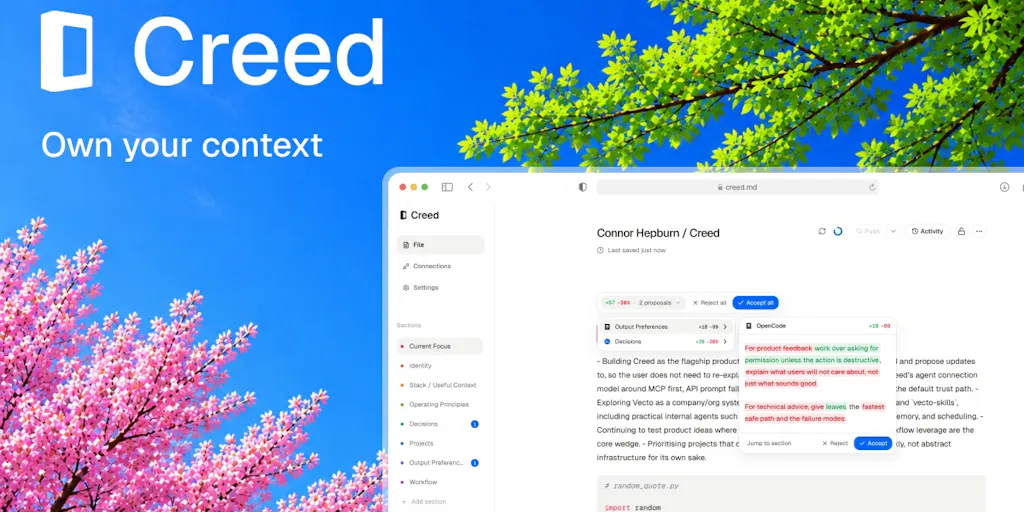
The most incisive comment comes from Abdullah Javaid, who dissects the context bloat problem. He notes that in the screenshots on Creed’s site, every diff adds lines, none remove— “+18 and +9 with a zero on the other side.” He predicts: “Accept a year of those and it is a long preamble pulled before every answer, mostly stale, all of it paid for on every call.” For a seller paying per-token for API calls (if you route through OpenAI or Anthropic), a bloated context file means higher costs and slower responses. Worse, stale rules—like a discontinued SKU or a retired pricing strategy—could trigger outdated actions. The math breaks if the file never shrinks. Does Creed or the connected agent ever propose a deletion? The source gives no indication. If you’re a seller with 500 line items of product specs, shipping rules, and compliance notes, you’ll need a way to prune what’s no longer true. Otherwise, you’re paying for the privilege of confusion.
What Cross-Border Sellers Can Borrow from This Concept
Even if you don’t integrate Creed tomorrow, the idea of a shared context file for AI tools is worth implementing in a simpler, more controlled manner. Here’s what I’d test this week:
Create a master
context.mdfile on your local machine or a shared cloud drive (Dropbox or Google Drive work fine). Include sections: Brand Voice, Product Catalog, Fulfillment Rules (per region), Return Policies, Pricing Constraints, and Compliance Notes (WEEE, TVA, etc.). Keep it under 2000 words to avoid token cost bloat. Update it weekly.For each AI tool you use (ChatGPT, Claude, Jasper), manually paste the context at the start of each session. Yes, it’s manual. But that forces you to notice what’s stale. After a month you’ll see which rules change most often and can automate only those lines.
Set up a version history (git or Google Docs versioning). That way you can audit which rule was used when an agent made an error. The commenter Nitish Garg mentioned a hand-maintained
AGENTS.mdper repo; for e-commerce, a singleAGENTS.mdper marketplace makes sense. Keep each file under 100 lines.Test one tool integration with a custom GPT first. Upload your master context as a file in a custom GPT (OpenAI’s ChatGPT interface). See if the staleness bothers you. If it does, you’ll understand why Creed’s promise of live sync matters—and why you need to demand verifiable live sync.
Where My Judgment Says It Falls Short
Creed is solving a real pain point, but in its current state (as of the Product Hunt launch), it’s not ready for a production e-commerce stack. Three gaps jump out:
No granular permissions. If every agent reads the full identity doc, your customer-service AI knows your wholesale costs and supplier contacts. That’s a security risk for any business with more than one employee. Until Creed supports scoped views (e.g., “agent A sees only brand voice and product listings; agent B sees only fulfillment rules”), I wouldn’t plug it into anything sensitive.
No staleness audit trail. The commenter Noctis Leonard’s question about cached snapshots is unanswered in the source. If an agent acts on a rule that you changed an hour ago, who’s liable? For a seller whose repricing agent adjusts prices based on old data, that could mean lost revenue or a suspended account (if Amazon’s algorithm detects erratic pricing). Creed needs a clear “last synced” timestamp visible to the user.
No diff or deletion mechanism. As Abdullah Javaid pointed out, the context file only grows. In e-commerce, rules change frequently: maybe you stop selling in Japan, or your carrier adds a dimension-based surcharge. A stale context file is worse than no context file because it silently creates false assumptions. Without a way to propose deletions or flag outdated lines, Creed will become a liability after a few months of edits.
I also note that the maker Connor Hepburn responds to a few comments but does not directly address the staleness sync or scope questions. That’s not a red flag—it’s a launch-day reality—but it means the product is likely early-stage. For a cross-border seller who values reliability over novelty, wait until those answers are public in a changelog or documentation.
What I’d Watch / Test Next
This week, I’ll manually implement a context.md file for my test Amazon brand, paste it into a custom GPT and Claude project, and track how many times I need to correct output because the agent didn’t respect a rule. If the error rate is under 10%, I’ll consider the manual approach good enough and look at Creed again when they ship scoped reads. If you’re eager to try Creed, I’d test it with one non-critical tool—say a blog-content generator—and see how often the context is stale. Then ask for the API details to verify the sync mechanism. The idea is sound; the execution needs hardening. For now, the most valuable takeaway is the concept: centralize your AI context, but own the file and the update process yourself until the tools catch up.