The Knowledge Chaos Tax Is Eating Your Margins — And Nobody’s Talking About It
Every cross-border operator I know runs the same silent gauntlet every morning. You wake up to a Slack ping about a supplier delay in Shenzhen, an Amazon Seller Central notification about a listing suppression, a Shopify order-fraud alert, and a TikTok Shop message from a creator who needs a product sample yesterday. The information you need to make a decision is scattered across five apps, three time zones, and two dozen unread threads. By the time you find the purchase order PDF, the supplier has already moved on to another buyer. This is the knowledge chaos tax — the invisible cost of context-switching that eats into your margins more than any ad-spend inefficiency or fulfillment surcharge ever will. It’s not a glamorous problem, but it’s the one that determines whether you scale or stall. And it’s exactly the problem that a new desktop tool called Contrive is trying to solve — not for e-commerce specifically, but for any team drowning in its own operational sprawl. Before you dismiss it as another productivity toy, consider what it reveals about the way you actually run your business.
The Real Problem: Search Is Not Discovery, and Discovery Is Not Action
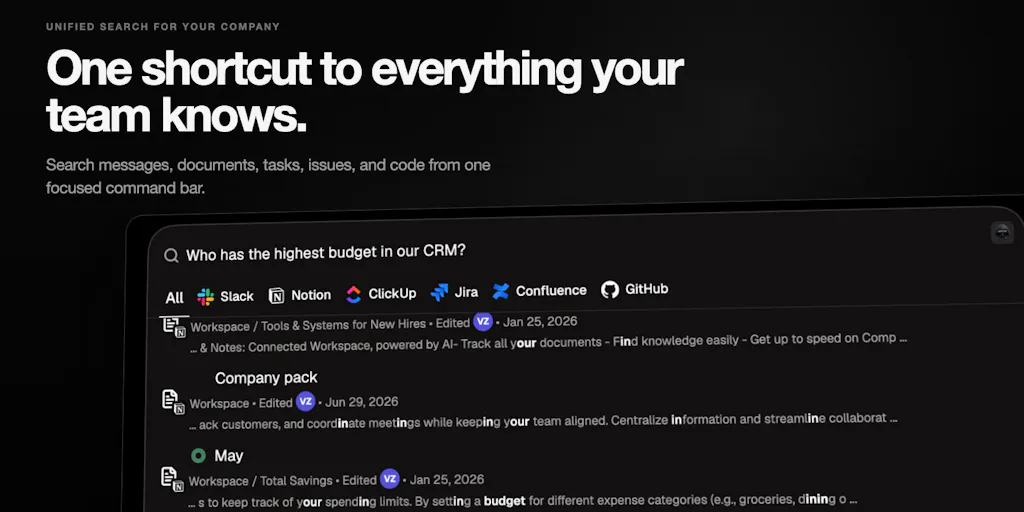
Let’s be brutally honest about how cross-border teams actually operate. We don’t have a knowledge problem — we have a retrieval-and-execution problem. The information exists. The supplier contract is in Google Drive. The inventory forecast is in a spreadsheet. The ad performance data is in Meta Ads Manager. The customer service escalation is in Zendesk. The issue is that finding the right piece of information at the right moment, and then acting on it without losing momentum, requires a level of organizational memory that most teams simply don’t have. Contrive frames itself as a “standalone, unified search and action layer for company knowledge” — and that framing is more relevant to cross-border e-commerce than the maker probably realizes. The tool’s core premise, as described by its maker Venceslav Zlatev, is that teams use many apps to store important knowledge in messages, documents, tasks, issues, code, and more, and to find something you need to remember which app holds the information, do a search, and switch between apps to perform actions. That’s a textbook description of a Monday morning in a DTC operation.
The killer feature isn’t the search itself — it’s the action layer. Contrive lets you search through connected work applications, view an AI Overview based on the original sources, and act on it all within one desktop command bar. You can create new pages, tasks, issues, pull requests, and more without switching back and forth between tools. For a cross-border operator, this is the difference between finding the thread where the supplier mentioned a raw-material price increase and actually creating a task to renegotiate the contract — without losing the context. It’s the difference between seeing a negative review trend in your feedback tool and immediately opening a ticket to investigate the product batch. The tool’s stated ambition is to “connect the discoverability with execution — search, understand, and act from the single interface.” That’s not a nice-to-have; that’s the operational backbone of a business that moves at marketplace speed.
Why Amazon sellers should care more than Shopify ones
If you’re running an Amazon FBA operation, your margin for error is razor-thin, and your information sprawl is arguably worse than any other channel. You’re juggling Seller Central, Helium 10 for keyword research, Jungle Scout for product validation, your ERP for inventory, your 3PL’s portal for inbound shipments, and a chat tool for communicating with your VA in the Philippines. Amazon’s own Seller Central is a labyrinth — finding a specific policy update or a customer message requires navigating through layers of menus that seem designed to hide information. A unified search layer that can pull from your internal tools and let you act on the results is not a convenience; it’s a competitive advantage. Shopify merchants, by contrast, tend to have a more centralized dashboard and a simpler operational stack — their problem is more often customer-facing (email, chat, social) than internal knowledge retrieval. The urgency is lower, the stakes are less existential.
How Contrive Differs From the Incumbents — and What That Means for Your Stack
The enterprise search space isn’t empty. You’ve got Glean positioning itself as the AI-powered workplace search for large companies, with deep enterprise integrations and a heavy IT-administration focus. You’ve got Notion AI bolted onto Notion’s workspace, which is great if your entire company lives inside Notion — but that’s rarely the case for a cross-border operation that relies on specialized tools like Asana for project management, Slack for real-time communication, and GitHub for any development work. You’ve also got the command-palette approach popularized by tools like Raycast or Alfred, which are powerful for launching apps and running quick scripts but don’t deeply index your company’s knowledge base. Contrive sits in a different niche: it’s a standalone desktop command bar that’s specifically designed to index your work applications and let you act on the results. It’s not trying to be your team’s single source of truth — it’s trying to be the layer on top of your existing chaos.
The difference matters for a cross-border seller. When you’re using Glean, you’re typically in a company of 500+ employees with a dedicated IT team to manage permissions and integrations. Your operation — even if you’re doing seven figures in revenue — is probably a team of 5 to 50 people spread across time zones. You don’t have an IT department to configure a complex enterprise search deployment. You need something that your operations manager can set up in an afternoon. Contrive’s emphasis on “selective indexing, roles and permissions” is a signal that it’s thinking about team control, not just individual productivity. That’s important because in a cross-border operation, you have different levels of access — your VA shouldn’t see your profit-and-loss spreadsheet, and your supplier shouldn’t see your customer email addresses. The fact that Contrive keeps teams in control of what gets indexed and who can see what is a practical feature, not a security checkbox.
Where the math breaks
Let’s talk about the hard numbers, because that’s where the rubber meets the road for an e-commerce operator. The product is currently free to try, but the pricing details are not disclosed in the launch material. That’s a yellow flag for me. Cross-border sellers are notoriously price-sensitive — not because we’re cheap, but because we’ve been burned by SaaS tools that promise the world and deliver a glorified search bar. If Contrive lands at $20 per user per month, it’s a no-brainer for a 10-person team. If it lands at $100 per user per month, you need to calculate the actual time savings. Let’s say your operations manager spends 30 minutes per day searching for information across apps. That’s roughly 120 hours per year. At $50 per hour fully loaded, that’s $6,000 of wasted labor. If the tool costs $1,200 per year for that one user and saves even half that time, it pays for itself. The math gets more complicated when you factor in the AI Overview feature — AI inference costs money, and the tool is generating an AI summary based on original sources every time you search. That’s a recurring cost that the maker will eventually need to pass on to users. The question isn’t whether the tool works; it’s whether the economics hold up at the scale of a lean cross-border team.
What Cross-Border Sellers Can Borrow From Contrive’s Philosophy
Even if you never download Contrive, the thinking behind it is worth stealing. The first lesson is the importance of a unified action layer. Too many e-commerce operators treat their tools as silos — they check inventory in one system, then switch to their messaging app to ask the warehouse manager about a discrepancy, then switch to their task manager to follow up. Each switch is a context loss. The Contrive philosophy is that search and action should be unified — you find the information and you act on it without leaving the context. You can replicate this with existing tools by setting up integrations: Zapier or Make can connect your inventory system to your task manager so that a low-stock alert automatically creates a purchase order task. The tool is just a catalyst for thinking differently about your workflow.
The second lesson is the power of selective indexing. Contrive’s approach to permissions is a reminder that not all knowledge should be equally accessible. In a cross-border operation, you have sensitive information — supplier costs, profit margins, customer data — that shouldn’t be visible to every team member. But you also have operational knowledge — standard operating procedures, shipping guidelines, product specs — that should be easily discoverable by anyone who needs it. The problem with most knowledge management systems is that they’re either too locked down (knowledge gets hoarded) or too open (knowledge gets lost in the noise). Contrive’s selective indexing approach is a middle ground: you control what gets indexed, and you control who sees what. That’s a governance model that cross-border teams should adopt even if they never use the tool.
The third lesson is the focus on the “answer —> task flow.” One of the comments on the Product Hunt page — from Miki Makhlevitch — nails it: “the answer –> task flow is the big unlock imo, people usually don’t just search out of curiosity.” That’s a profound insight for e-commerce operations. When someone searches for a supplier’s lead time, they’re not curious — they’re trying to decide whether to place a rush order. When someone searches for a customer’s order history, they’re not exploring — they’re trying to resolve a return request. The search is always in service of a task. If your tools don’t connect the search to the action, you’re forcing your team to hold context in their heads while they switch apps. Contrive’s design recognizes this, and it’s a principle that should inform how you build your own operational workflows.
The integration gap that will make or break it
Here’s where my judgment gets skeptical. The launch post asks which work apps should be integrated next, which actions would save the most time, and what would make Contrive irreplaceable. That’s a good sign — the maker is listening — but it also reveals that the tool is early-stage. For a cross-border seller, the make-or-break integrations aren’t just Slack and Notion. They’re Amazon Seller Central, Shopify Admin, ShipStation, Cin7, and the various marketplaces’ seller portals. If Contrive can’t index your Amazon orders or your Shopify customer data, it’s just another search tool for a different kind of business. The maker has a vision for unifying company knowledge, but the tool’s value for e-commerce will hinge on whether it can connect to the specialized, often-clunky platforms that cross-border sellers actually use. Until those integrations exist, the tool is more relevant to a software startup than to an Amazon FBA brand owner.
Where My Judgment Says It Falls Short
Let me be direct: Contrive is not ready for prime time in cross-border e-commerce. The launch is a promising proof of concept, but it’s built for a knowledge-worker team — think engineering, product, design — not for an operations-heavy business that lives in logistics portals and marketplace dashboards. The integrations that matter to you — ShipBob, Flexport, your freight forwarder’s tracking system, your 3PL’s inventory API — are not on the list. The tool’s strength is in unifying documents, tasks, and issues, which is great if your team runs on Linear, Jira, and Confluence. But a cross-border operation runs on purchase orders, shipping manifests, customs forms, and marketplace performance dashboards. Those aren’t typical knowledge-management apps, and they don’t fit neatly into a search-and-action layer.
There’s also the adoption problem. A desktop command bar is a power-user tool. Your operations manager might love it, but your customer service rep in Manila or your warehouse lead in California probably won’t adopt it unless it’s deeply integrated into their daily workflow. The tool’s value increases with the number of connected apps and the number of team members using it, but it starts with a single user. For a cross-border seller, the ROI calculation is murky: you’d need to get multiple team members to change their behavior — to stop opening Slack directly and instead use the command bar — before you see the network effects. That’s a behavioral change that’s harder to drive than a software implementation.
The security and compliance question you can’t ignore
Cross-border e-commerce involves sensitive data — customer personally identifiable information (PII), payment details, supplier contracts, and proprietary product designs. A tool that indexes all your company knowledge and makes it searchable via a global hotkey is a double-edged sword. On one hand, it makes information more accessible to your team. On the other hand, it creates a single point of failure for data exposure. If a laptop is lost or stolen, and the tool’s local cache isn’t encrypted, you’ve just handed a thief the keys to your entire operation. The launch material mentions roles and permissions, but it doesn’t detail the encryption standards, data residency options, or audit logs. For a seller operating across borders — and therefore subject to GDPR in Europe, CCPA in California, and various data localization laws in Asia — this is a critical gap. You’d need to do significant due diligence before letting Contrive index your customer database or your supplier agreements.
What I’d Watch / Test Next
Here’s what I’d do this week if I were running a cross-border operation and thinking about the knowledge chaos tax.
First, audit your own search-and-action gaps. For one day, have your operations manager track every time they search for information across your tools. Note which app they searched in, what they were looking for, and what action they took afterward. You’ll likely find that 80% of searches fall into a few recurring patterns — checking order status, looking up a supplier contact, finding a product spec. Those patterns are your candidates for automation or unification.
Second, test Contrive with a small, non-sensitive subset of your tools. Connect it to your project management and documentation tools — not your customer database or financial systems — and see if the search-and-action flow actually saves time. The tool is worth a weekend experiment, but keep it isolated from your core operational data until the security details are clarified. The launch material doesn’t disclose pricing, so treat it as a free trial and evaluate whether the time savings justify the eventual cost.
Third, build your own lightweight “answer —> task” flows using existing tools. If you’re on Slack, use Slack’s built-in workflow builder to turn common questions into automated actions. If you’re on Shopify, set up Shopify Flow to automate repetitive tasks based on order or customer triggers. The goal isn’t to replicate Contrive — it’s to adopt the philosophy that search should lead to action, not just to more context.
Finally, watch the integration roadmap. If Contrive announces integrations with Amazon Seller Central, Shopify, or major logistics platforms, that changes the calculus significantly. The maker is asking for feedback on which work apps to integrate next — that’s your chance to vote with your voice. Tell them what a cross-border seller actually needs. The tool’s vision is sound; the execution just needs to meet the operational reality of a business that lives and dies by its supply chain.
The knowledge chaos tax is real, and it’s only going to get worse as your operation scales. The question isn’t whether you need a unified search-and-action layer — you do. The question is whether Contrive is the tool that delivers it for your specific stack. Right now, it’s a promising start with the right philosophy and the wrong integrations for cross-border e-commerce. But the philosophy is worth stealing, the experiment is worth running, and the roadmap is worth watching. Your margins will thank you.