Why a Virtual Chip Lab Matters More Than Another SaaS Dashboard
Every cross-border seller I know has hit the same wall: you’ve validated the product, you’ve got the P&L roughly figured out, and then you wait. You wait for the hardware sample. You wait for the firmware engineer to finish debugging the last project. You wait for the dev board to ship from Shenzhen, clear customs, and arrive at your contract manufacturer’s bench. That waiting period is where margins die and launch windows close. For anyone selling smart hardware — an IoT gadget, a smart home device, a wearable — the gap between “we have the idea” and “we have working firmware” is the most expensive silence in the entire operation.
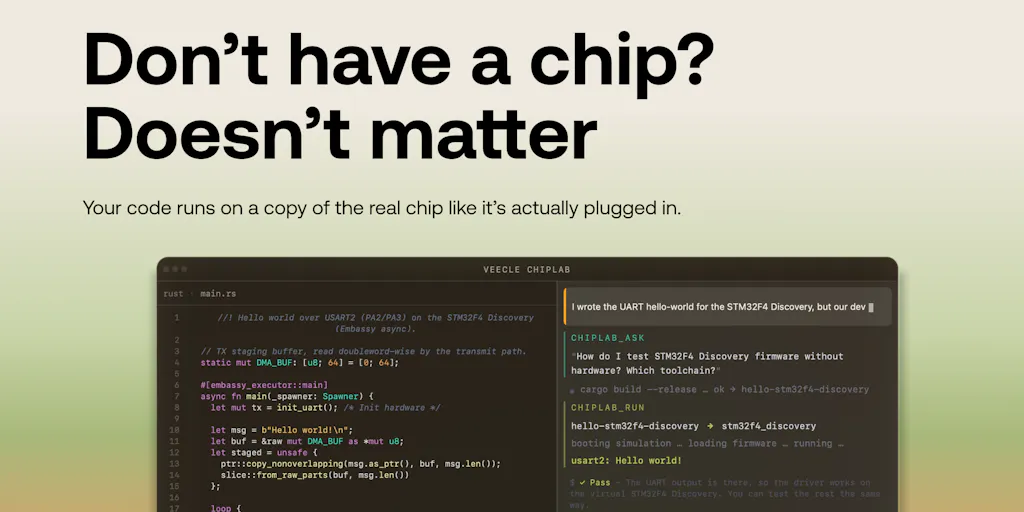
So when I saw Chiplab on Product Hunt, I didn’t see another dev tool. I saw a way to compress that silence. Chiplab is an MCP server that lets AI coding agents build, run, and test embedded firmware on a virtual copy of the real chip — no physical board required. For the Amazon FBA seller who’s been burned by a six-week hardware iteration cycle, or the Shopify DTC brand trying to ship a connected product before the holiday tariff window closes, this is not a niche concern. It’s a supply chain advantage hiding inside a developer utility.
The pitch from Veecle, the company behind it, is straightforward: their tool lets your AI agent develop correct embedded code from day one by using datasheets, manuals, and results from all runs, then executes that code on a virtual instance of the real chip. It reads crashes for you, gets better with every run, and runs across all boards at once instead of one at a time. No custom hardware or tooling required. Connect your agent, and it’s ready.
That’s the product. But what does it actually mean for someone who’s never written a line of embedded C in their life? It means the firmware bottleneck — the thing that has quietly killed more hardware startups than any demand-side problem — just got a lot more permeable.
The Datasheet Tax: What Chiplab Actually Eliminates
Let me tell you a story that will resonate with anyone who’s ever tried to bring a hardware product to market. The founder of Veecle, Sohyeon Park, describes it in the launch post: years ago, she spent hours in a car flipping through a several-hundred-page datasheet just to find one signal. Then she ordered a board and lost weeks waiting for it to ship before she could even start. And when it finally arrived, she still had to wait her turn for the single setup the team shared.
That’s the datasheet tax. It’s not just the time spent reading — it’s the time spent waiting to read, waiting to test, waiting for physical access to a piece of silicon that costs fifty dollars and takes three weeks to arrive. For a cross-border operator, that tax compounds. You’re not just paying for the engineer’s hours; you’re paying for the calendar days that tick past while your inventory sits in a warehouse in Dongguan, unprogrammed and unsellable.
Chiplab attacks this from two angles. First, it gives the AI agent access to the datasheets and manuals directly — so the agent can parse the documentation itself rather than making the human do it. Second, it provides a virtual instance of the chip, so the agent can run code and see results immediately, without waiting for a physical board.
What this means in practice: your firmware engineer (or your AI agent, if you’re running lean) can iterate on a register configuration or a peripheral driver in minutes, not days. The feedback loop that used to require a hardware order, a shipping wait, and a shared lab bench now happens in the same session where the code was written.
The supported chips today are STM32 (F1, F4, F7, H7, L0, WBA) and Nordic (nRF52), with OS and framework support for Bare-metal, Embassy-Rust, Zephyr, FreeRTOS, and Eclipse ThreadX. Languages are C/C++ and Rust. That’s a meaningful slice of the smart-device market — STM32 and nRF52 are everywhere in consumer IoT, from fitness trackers to smart plugs.
Why Amazon Sellers Should Care More Than Shopify Ones
Here’s a hot take: if you’re running a pure software or digital products Shopify store, Chiplab is interesting but not urgent. You don’t have firmware. But if you’re selling physical goods on Amazon — especially anything with a battery, a sensor, or a wireless radio — this matters more than almost any marketing automation tool you’re currently evaluating.
The reason is the Amazon hardware flywheel. On Amazon, your listing rank depends on review velocity and return rates. Both of those are brutally sensitive to firmware quality. A device that crashes on setup generates a one-star review and a return. A device that fails to pair with the app generates a flood of support tickets. The cost of a firmware bug on Amazon isn’t just the engineering time to fix it — it’s the ranking damage that takes months to recover from.
Chiplab’s ability to run tests across all boards at once, rather than one at a time, is the unsung hero here. If you’re shipping a product that supports both STM32 and nRF52 variants, you can run your test matrix in parallel on virtual hardware instead of serializing it on physical boards. That’s the difference between a two-week regression cycle and a two-day one. And for an Amazon seller, two weeks of regression testing can be the difference between hitting the Q4 window and missing it entirely.
How Chiplab Differs From the Incumbent Tooling
Let’s be honest about what’s out there today. The embedded development world is not short on tools — it’s short on tools that talk to each other. The typical stack looks like this: STM32CubeIDE or Keil for the IDE, Segger J-Link for debugging, QEMU for some emulation, and a pile of custom scripts to glue it together. None of it is designed for AI agents. None of it is designed for parallel execution. And none of it reads crashes for you.
The incumbents solve the “how do I compile and flash” problem. Chiplab is solving a different problem: how do I let an AI agent own the entire loop — from reading the datasheet to running the code to interpreting the crash — without a human in the middle?
This is where the MCP (Model Context Protocol) piece matters. MCP is the emerging standard for giving AI agents access to tools and data. By building Chiplab as an MCP server, Veecle is making it plug-and-play for any AI coding agent that supports the protocol. That’s a smarter bet than building a proprietary IDE or a standalone agent. It means the tool gets better as the ecosystem of AI coding agents gets better, rather than being locked to one vendor’s LLM.
The other differentiator is the virtual chip model itself. Traditional emulators like QEMU give you a generic CPU core — they don’t model the peripherals, the memory map, or the quirks of a specific STM32 variant. Chiplab runs your code on a virtual instance of the real chip, which means the agent can catch bugs that a generic emulator would miss — things like a misconfigured GPIO alternate function or a timing issue on a specific peripheral.
For a cross-border seller, the practical implication is simple: your firmware engineer (or your AI agent) can validate code against the actual silicon behavior, not a generic approximation. That’s the difference between a device that works on the bench and a device that works when a customer in Ohio unboxes it at 9 PM on a Tuesday.
Where the Math Breaks
Now let’s talk about the honest limitations, because every tool has them, and pretending otherwise is how sellers get burned.
First, the chip support is narrow. STM32 and nRF52 cover a lot of ground, but they don’t cover everything. If you’re building on ESP32 — which is incredibly common in budget IoT devices — you’re out of luck for now. The launch comments show a user asking for ESP support, and the Veecle team saying it’s on the timeline, ideally around September. That’s a real gap for sellers who’ve standardized on Espressif parts to hit aggressive BOM targets.
Second, this is a beta product. The launch post explicitly says peripheral support and CI/CD integration are coming next week, and that it’s free to use while in beta. That means the tool is changing rapidly, and the documentation may not keep pace. For a seller who needs stability — who needs to know that the tool they validated today will behave the same way next month — beta software is a risk, not a feature.
Third, the “reads crashes for you” promise is only as good as the crash data the tool has seen. In the early days, the tool is learning from its own runs. That’s fine for common patterns, but it may struggle with the weird, vendor-specific, board-specific issues that only show up in production. The tool gets better with every run — that’s the pitch — but “better” is not “perfect,” and the tail of unusual failures is where firmware projects go to die.
Finally, there’s the question of who this is for. The tool is designed for embedded engineers and teams who want their AI agent to carry the work all the way through. If you’re a seller who doesn’t have an embedded engineer on staff — who’s outsourcing firmware to a contract house — this tool doesn’t replace that relationship. It makes your contractor faster, which is good, but it’s not a magic wand that lets a non-engineer ship firmware.
What Cross-Border Sellers Can Borrow From Chiplab
Even if you never write a line of embedded code, there are three lessons from Chiplab that apply directly to your operation.
Lesson one: virtualize before you physicalize. The entire premise of Chiplab is that you shouldn’t need physical hardware to make progress on firmware. The same logic applies to your broader operation. Before you order a full MOQ from your factory, can you validate the product concept with a virtual prototype? Before you commit to a freight forwarder, can you simulate the landed cost with different shipping scenarios? The tools for virtual validation exist — Shopify for storefront testing, Amazon Seller Central for listing testing, Helium 10 for keyword validation. The question is whether you’re using them to compress your own waiting periods, or whether you’re still ordering the board and waiting for it to ship.
Lesson two: parallel beats serial. Chiplab runs across all boards at once instead of one at a time. That’s a mindset shift, not just a feature. Most sellers run their testing and validation serially — they test the listing, then the ad creative, then the pricing, then the fulfillment. But the sellers who win are the ones who run experiments in parallel. If you’re not testing three ad creatives against each other simultaneously, if you’re not A/B testing your product images while you’re still negotiating with the factory, you’re leaving cycle time on the table.
Lesson three: let the agent read the datasheet. The killer feature of Chiplab is that the AI agent reads the datasheet, the manuals, and the run results — so the human doesn’t have to. The equivalent for a cross-border seller: stop reading every policy update from Amazon or TikTok Shop manually. Use an AI tool to parse the policy changes, extract what’s relevant to your category, and alert you when something changes. The tools for this exist — Klaviyo for email automation, Zapier for workflow automation, and a growing stack of AI-powered copilots. The question is whether you’re using them to delegate the reading, or whether you’re still flipping through the datasheet in the car.
My Judgment: Where Chiplab Falls Short and Where It Wins
Let me be direct about my assessment. Chiplab is not a tool for every seller. It’s a tool for sellers who are shipping products that contain a microcontroller — which is a meaningful subset of the cross-border hardware world, but not the whole thing. If you’re selling phone cases or candle holders, this is irrelevant to you. If you’re selling a smart thermostat or a connected pet feeder, this is directly relevant.
The tool wins on vision. The idea that an AI agent can own the entire embedded development loop — from datasheet to crash analysis — is the right bet. The embedded world has been underserved by the AI tooling wave, which has focused almost entirely on web apps and websites. The launch post makes this explicit: every new AI coding tool seemed built for apps or websites, and embedded developers were left behind. Chiplab is addressing that gap, and the timing is right.
The tool falls short on coverage and maturity. The chip list is narrow, the beta status means things will break, and the ESP32 gap is a real problem for a large segment of the market. The team’s response in the comments — that ESP support is coming around September — is encouraging, but “coming” is not “here.” For a seller planning a Q4 launch on an ESP32-based product, Chiplab is not a tool you can rely on today.
There’s also a question of trust. The tool reads crashes and gets better with every run, but the early runs are the ones where it has the least data. For a seller who needs to ship thousands of units, the first few runs are the ones that matter most. A tool that gets better over time is great, but the cost of a bad first run — a crash that ships to customers — is high.
The Supply Chain Angle Nobody’s Talking About
Here’s something the launch post doesn’t mention, but which matters deeply for cross-border sellers: firmware is a supply chain input, not just an engineering artifact. When your firmware isn’t ready, your factory can’t flash the chips, which means your production line is idle, which means your freight booking slips, which means your launch date moves, which means your ranking on Amazon starts from zero instead of building on pre-orders.
Chiplab’s virtual chip lab compresses that supply chain risk. If your firmware can be validated and tested before the physical boards arrive, then the day the boards land at your factory, you’re ready to flash and ship. You’re not waiting for a firmware iteration that should have happened three weeks ago. For a seller who’s ever been stuck in that loop — watching the factory sit idle while the engineer debugs a register configuration — the value proposition is immediate.
I’d also note that the tool’s ability to run across all boards at once has a procurement implication. If you’re sourcing from multiple chip vendors to hedge against shortages — which is a smart strategy in this market — you need firmware that runs on both. Chiplab lets you validate both variants in parallel, so you’re not in a position where one chip is ready and the other isn’t, and you’re forced to choose between delaying the launch or paying a premium for the ready chip.
What I’d Watch / Test Next
If you’re a cross-border seller with hardware in your pipeline, here’s what I’d do this week, not next month.
First, go to chiplab.veecle.ai and take the beta for a spin. It’s free while it’s in beta, and the launch post explicitly asks for feedback on what to support next. If you’re on STM32 or nRF52, you can start testing today. If you’re on ESP32, get on the waitlist and tell them you need it — the comment thread shows the team is responsive, and the more demand they see, the faster they’ll ship ESP support.
Second, map your firmware validation process end to end. Where are the waiting periods? Where are you serializing tests that could be parallelized? Where are you relying on physical hardware when a virtual model would do? You don’t need Chiplab specifically to answer these questions, but the questions are worth asking. If you find that your firmware cycle is dominated by waiting for boards to ship or waiting for a shared bench, then a virtual chip lab is worth serious investment.
Third, if you’re not already using AI agents in your development workflow, this is the moment to start. The launch post makes the case that AI coding tools have been built for apps and websites, leaving embedded behind — but that gap is closing fast. The sellers who figure out how to delegate the datasheet reading to an agent, and who keep their human engineers focused on the architecture and the hard problems, will have a structural advantage over those who don’t.
Finally, keep an eye on the Veecle website and the public repo. The team says peripheral support and CI/CD integration are coming next week, and that means the tool is about to get a lot more useful for production workflows. If you can wire Chiplab into your GitHub and run real test scenarios as part of your CI pipeline, that’s the moment where this stops being a beta toy and starts being a serious piece of your supply chain tooling.
The hardware world is learning what the software world figured out a decade ago: the tools that win are the ones that collapse the distance between idea and execution. Chiplab is aiming at that distance for embedded development. For cross-border sellers who’ve been burned by the wait, that’s a bet worth watching.