The Overnight Agent Run Is Now a Supply-Chain Problem
Cross-border sellers have quietly turned into AI operators. The same person who reconciles a Shopify payout on Monday is running Claude Code against a supplier spreadsheet on Tuesday, and letting a coding agent chew through a bulk listing rewrite overnight on Wednesday. That last habit is where things break: your laptop sleeps, the agent stalls mid-run, and you wake up to a half-finished job and a wasted subscription window. Awakado, a small Mac utility from a studio in New Zealand, is a narrow fix for exactly that failure mode — and the narrowness is the interesting part. It tells you something about where agent-driven operations are heading, and where the current tooling still leaves money on the table.
What Awakado Actually Does, Stripped of Launch-Page Gloss
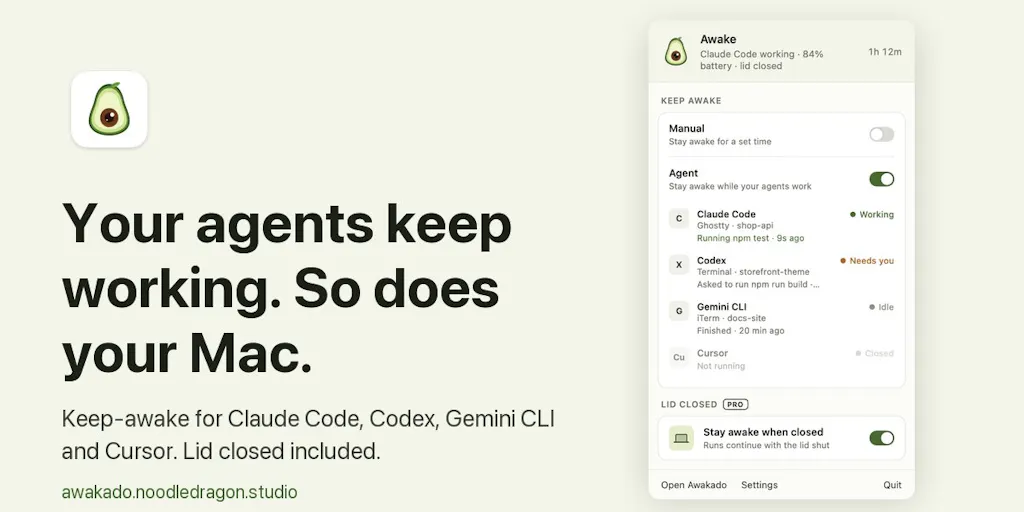
The pitch is simple enough to state in one breath: your Mac keeps falling asleep during long agent runs, so this app keeps it awake — but only while an agent is genuinely working. It hooks into each agent’s own lifecycle signals rather than guessing from CPU load or mouse movement, which means it can distinguish four states that matter: working, waiting on you, stuck at a usage limit, and done. After the last agent finishes, it lets the machine sleep a few minutes later.
That state awareness is the whole product. The maker, Tony Hou, frames the origin story as personal frustration — a Mac dropping into sleep mid-run during long Claude Code sessions — and the fix is deliberately conservative: stay awake only while something is actually running.
The feature worth paying attention to sits behind Pro. If Claude Code hits its usage limit at 2 a.m., Awakado lets the Mac sleep and wakes it two minutes before the limit resets, so the run resumes while you’re asleep. A commenter on the launch thread, Michal Rachtan, called that the clever part, and he’s right — it’s the difference between “my machine doesn’t nap” and “my work queue survives the night.”
Pricing is a one-time $9.99 for three Macs, with a free download tier. The studio is described as small and New Zealand-based. No subscription, no per-seat math. That’s a deliberate positioning choice, and it tells you the maker expects this to be a utility, not a platform.
Why Amazon Sellers Should Care More Than Shopify Ones
Here’s my read on who actually benefits. If you run a lean Shopify DTC brand, your agent work is mostly content and creative — product descriptions, ad variants, email flows in Klaviyo. Losing a run costs you an hour of regeneration.
If you run Amazon FBA and touch Amazon Seller Central at scale, the calculus changes. Bulk listing edits, catalog cleanup, keyword harvesting, review-mining, competitor price pulls — these are long, boring, high-volume jobs where a mid-run death means partial writes and inconsistent state. A half-applied bulk update across a few hundred ASINs is materially worse than a half-written blog post. The sellers who feel this pain most are the ones running agent workflows against structured data, and that’s disproportionately the marketplace crowd.
The Real Problem Isn’t Sleep — It’s Unattended Throughput
Let me push past the product description to the underlying shift.
For the last two years, cross-border tooling has been about dashboards: Helium 10 for research, Jungle Scout for validation, Klaviyo for retention, Gorgias or Zendesk for support. Those tools assume a human is looking at a screen. The new wave — agentic coding and ops tools — assumes the human is asleep and the machine is still working. That’s a fundamentally different reliability contract.
Awakado is one of the first consumer-priced products I’ve seen that treats “the agent is still running” as a first-class system state. It’s not a dashboard. It’s plumbing. And plumbing is where cross-border operations have always leaked margin: payment reconciliation that fires at the wrong time, inventory syncs that half-complete, ad-budget rules that trigger against stale data.
The 2 a.m. usage-limit wake-up is a small feature, but it’s a template. Once you accept that an agent can be paused by an external quota and resumed by a scheduled wake, you’ve admitted that agent runs are schedulable jobs — and schedulable jobs are something operations people already know how to manage. Cron, queues, retries, dead-letter handling. The vocabulary transfers.
Where the Math Breaks
I want to be honest about the economics, because the launch framing invites a comparison that doesn’t hold.
$9.99 one-time for three Macs is roughly the cost of two coffees. Against that, consider what an overnight agent run is worth to you. If you’re paying for a Claude subscription and burning a usage window on a job that dies at 60 percent, you’re not just losing time — you’re losing quota you already paid for. The break-even is almost embarrassingly low.
But the math breaks in two places. First, the tool only helps if your work is genuinely long-running and genuinely unattended. A seller who runs short, interactive agent sessions gets nothing from it. Second, and more importantly, it only helps if the agent’s own hooks are reliable. The maker explicitly says the app listens to each agent’s hooks — so the product’s value is downstream of the agent vendor’s instrumentation. If Anthropic changes how Claude Code reports state, or if you’re running a different agent that doesn’t expose equivalent hooks, the whole thing degrades. You’re renting reliability from someone else’s API surface, and you’re paying $9.99 for the privilege. That’s fine. It’s just not a moat.
What Cross-Border Operators Should Actually Borrow From This
Strip away the Mac-specific packaging and there are three transferable ideas here, and I think they’re worth more than the app itself.
First: instrument the agent, not the machine. Awakado doesn’t infer work from CPU spikes. It asks the agent. Every operator running agents against their store data should be doing the same thing at a higher level — logging agent state transitions into your own system so you can answer “what ran last night, what finished, what died, and what did it write?” Most sellers I talk to can’t answer that question about their own automations, and that’s a bigger risk than a sleeping laptop.
Second: treat quota resets as scheduling primitives. The 2 a.m. wake-up is clever because it converts a hard external constraint into a schedulable event. Apply that logic to your own stack. Rate limits on marketplace APIs, ad-platform daily budget resets, payment-processor settlement windows, TikTok Shop flash-sale windows — all of these are clocks you can schedule against. Most sellers treat them as obstacles. The good ones treat them as triggers.
Third: sleep is a cost, not a default. The reason this product exists is that someone noticed idle hardware is wasted capacity. That instinct generalizes. If you’re running fulfillment through a 3PL and your order routing only fires during business hours, you’re leaving overnight capacity unused. If your Temu or SHEIN listing sync runs once daily at a fixed time, you’re not exploiting the fact that your competitors’ syncs probably run at the same time. Timing is a competitive edge, and most sellers don’t treat it as one.
A Sidebar on the Agent-Support Question
The maker closes by asking which agents people want supported next. That’s the right question, and it’s also the product’s biggest open risk.
Right now the value is concentrated in Claude Code. If you’re running Cursor, GitHub Copilot, or a homegrown agent against your Shopify Admin API, you’re outside the supported set until the maker adds hooks for them. For a cross-border seller whose automation is mostly spreadsheet-and-API glue rather than a coding agent, this product is currently a solution looking for your problem. That’s not a criticism — it’s a scoping reality. Small studios ship narrow first. But it means the “which agents next” thread is genuinely load-bearing, not marketing.
Where My Judgment Says It Falls Short
Three things.
It’s Mac-only, and cross-border ops is Windows-heavy. The warehouse laptop, the VA workstation, the accountant’s machine — a lot of that is Windows. A Mac-only utility excludes a meaningful chunk of the operators who’d benefit most, especially the ones running fulfillment and finance workflows rather than coding agents.
The Pro feature is a single trick. Waking two minutes before a reset is genuinely useful, but it’s one behavior. If you don’t hit usage limits regularly — or if you’re on a plan where you don’t — Pro is $9.99 for nothing. The free tier is probably sufficient for most casual users, which raises the question of what the paid tier looks like in twelve months.
No visibility layer. This is my biggest reservation. The app knows when agents are working, waiting, stuck, and done. That’s telemetry. It doesn’t surface it anywhere you can act on it across a fleet of machines or a team. For a solo seller, fine. For an agency running agent workflows across ten client stores, the state data is the valuable part, and it’s trapped in a menu-bar app. I’d want an export, a log, or a webhook. Not disclosed whether that’s on the roadmap.
The Comparison I’d Actually Make
If you’re evaluating this, the honest comparison isn’t to other “keep your Mac awake” utilities — those are commodity. The comparison is to what you’d otherwise do: run the agent on a cheap always-on VPS, or accept the interruptions, or babysit the run.
A $5/month VPS solves the sleep problem permanently and gives you logs, cron, and headless execution. Awakado costs $9.99 once and solves it only on the Mac you already own. For a seller whose agent work is occasional and tied to their laptop, Awakado wins on convenience. For anyone running this as production infrastructure, the VPS wins on everything except setup time. I’d tell most sellers to think hard about which category they’re in before buying.
What I’d Watch / Test Next
This week, do three things.
First, before you buy anything, audit your last month of agent runs. How many died overnight? How much paid quota did you burn on incomplete jobs? If the answer is “none, I run everything interactively,” skip this product entirely and revisit in six months.
Second, if you do run overnight jobs, test the free tier against your real workflow for a week. Specifically, watch whether the state detection actually matches what your agent is doing — the whole value proposition rests on those hooks being accurate, and a week of real runs will tell you more than any launch thread.
Third, and most importantly, take the scheduling idea and apply it somewhere with real money attached. Pick one constraint in your stack — a marketplace API rate limit, an ad-budget reset, a payment settlement window — and build a trigger around it. That’s the durable lesson from a $9.99 Mac app. The app is disposable. The instinct to schedule against external clocks is not.