Why a Journaling App That Locks You Out Deserves Your Attention as a Seller
Every cross-border operator I know keeps two sets of books. One is the official P&L — clean, defensible, ready for the accountant. The other is the raw, messy log of what actually happened: the ad account that quietly bled cash for three days, the supplier who missed spec by a millimeter, the listing that got suppressed for a reason you still don’t fully understand. We rewrite the first set constantly. The second set, if we’re honest, we often rewrite too — not out of malice, but out of convenience. Memory is a terrible CRM. It smooths over the ugly parts, inflates the wins, and convinces us that the data anomaly we ignored was never really there. So when a small utility like at8pm shows up on Product Hunt with a philosophy of enforced, uneditable record-keeping, I don’t see a journaling app for teenagers. I see a design principle that attacks a very expensive problem in our industry: self-deception in operational data.
The product itself is simple, almost to a fault. But the constraint it introduces — a lock that prevents you from revising your own history — is a feature that maps directly onto how we should be treating our ad spend logs, our inventory counts, and our post-mortem notes. This essay isn’t a review of a diary. It’s an argument for borrowing the constraint, and a look at why the most useful tool in your stack might be the one that refuses to let you be kind to yourself after the fact.
The Problem It Actually Solves: You Are an Unreliable Narrator of Your Own Operations
The maker, Vince Urag, frames the core issue in his launch comment with a precision that most enterprise software vendors miss. He says most journaling apps let you edit, rewrite, or delete anything, which makes it “too easy to unintentionally rewrite your own history.” That is the entire thesis. It’s not about data loss or privacy in the conventional sense. It’s about the quiet corruption that happens when you allow retroactive edits to become a habit.
For a solo journaler, that corruption is emotional — you remember the trip as better than it was, the argument as less your fault. For a seller running a seven-figure Amazon business or a DTC brand with a Shopify storefront, that corruption is financial. Think about how you actually use your analytics dashboards. When you’re in Helium 10 or Seller Central, you’re looking at immutable numbers — Amazon doesn’t let you edit your sales history. But the interpretation of those numbers, the notes you take, the Slack messages you send your VA about why the ACOS spiked — that narrative is fully editable. And we edit it constantly. We tell ourselves the spike was seasonal, not a broken creative. We tell ourselves the return rate is fine because the product is “new.” We build a polished, coherent story that looks good in a quarterly review but is worthless for actually fixing the problem.
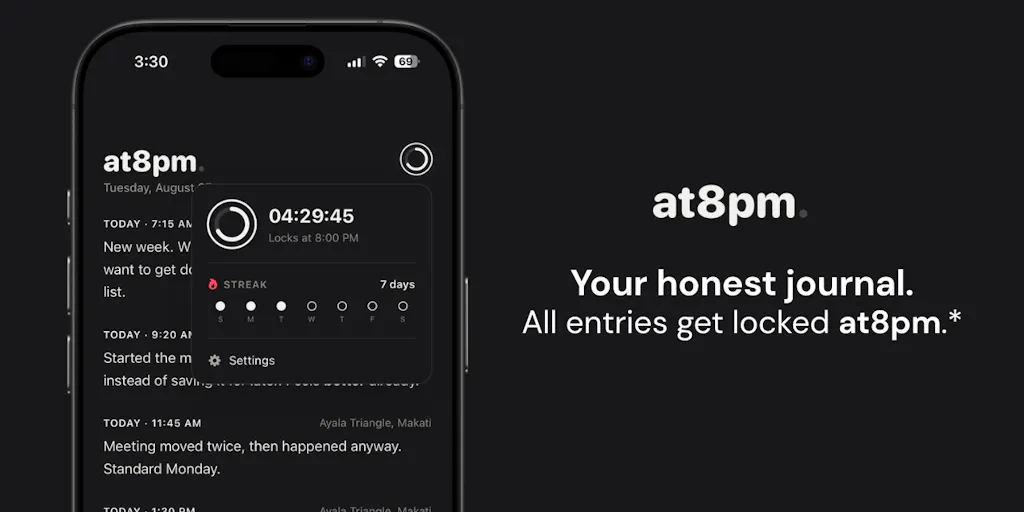
at8pm attacks this by making the entry immutable. You write it at 8 PM, or whenever you set the lock, and after that, it’s frozen. You can’t go back on a bad day and soften the language. You can’t delete the entry where you admitted you didn’t check the buy box before the deal ran. The app forces you to live with your first draft of the truth. For a cross-border seller, that is the difference between a post-mortem that identifies a root cause and a post-mortem that identifies a scapegoat. The discipline of not editing your own operational diary is the first step toward actually reading the data that’s in front of you, rather than the data you wish you had.
Why Amazon Sellers Should Care More Than Shopify Ones
If you’re running a brand on Shopify, you have a direct line to your customer data. You can see the LTV, the repeat rate, the email capture. You have a thousand tools to analyze behavior. The problem isn’t a lack of data — it’s a lack of honest reflection on that data. But for an Amazon FBA operator, the problem is different. Amazon gives you some data, but it’s filtered through a lens that serves Amazon’s interests first. You’re operating in a fog. When you get a performance notification, or a sudden dip in impressions, you have to act on incomplete information. In that environment, the temptation to rewrite your own history is even stronger, because the external record is so thin.
If you’re an Amazon seller, your journal is your only real record of the why behind the numbers. When your inventory gets stranded at an FBA warehouse due to a dimension change you didn’t catch, you need to know exactly when you first suspected the issue. If you’re using an app like at8pm to log your daily operational fears and suspicions — not just the facts, but the gut feelings — the lock becomes a legal document of your own due diligence. You can’t later claim you didn’t know about the supplier’s quality issues if you wrote it down and couldn’t delete it. It’s a liability shield and a process-improvement tool rolled into one.
How It Differs From Existing Options: The Default Is the Differentiator
The market for journaling and note-taking apps is crowded with incumbents that have vastly more features. Obsidian, mentioned by a commenter on the launch page, is a powerful knowledge base with a plugin ecosystem. Notion is a flexible workspace. Day One is the polished, popular journaling app with cloud sync and multimedia support. What all of them share is an assumption that the user is the master of their content — that they should be able to edit, delete, or restructure at will. That’s the standard feature set.
at8pm inverts that assumption. The lock is the product, not an add-on. The default is that you cannot edit. This is a fundamentally different design philosophy. It treats the user’s future self as an untrusted party who needs to be prevented from tampering with the evidence. In the SaaS world, we talk about “customer success” and “flexibility,” but there’s a growing recognition that too much flexibility leads to decision paralysis or, worse, self-deception. The app is betting that constraint is a feature, not a bug.
For cross-border sellers, this is a lesson in tooling. We often buy the most feature-rich software because we’re afraid of missing out on a capability. We buy Klaviyo for email flows we never finish building. We buy Jungle Scout for product research we do twice a year. We buy the enterprise plan for the API access we never use. The at8pm philosophy suggests we should instead buy tools that enforce a specific, beneficial constraint. A tool that prevents you from editing your bid history might be more valuable than a tool that allows you to see it in a fancy chart. The lock forces a behavior change, which is harder than a feature add.
Where the Math Breaks: The Time Zone Problem and the Editing Paradox
The product is not without its practical wrinkles. A commenter, Gal Dayan, raises a sharp question about the lock mechanic: if you’re traveling across time zones, does the configured lock time follow your phone’s local time, or does it stay anchored to the setup zone? This is a small detail, but it’s the kind of edge case that kills adoption for a global audience — which, if you’re selling across borders, is exactly your audience. The answer isn’t disclosed in the source, so we don’t know. But the question highlights a broader issue: tools built for a single market often fail to account for the logistics of a distributed team or a traveling operator. If I’m a US seller checking on my shipments from a warehouse in Shenzhen, my “8 PM” is a different 8 PM.
There’s also a deeper paradox. The value of the lock is that it preserves your raw, unfiltered thoughts. But what if you made a factual error? What if you wrote that the container was loaded on the 15th, and you later find out it was the 14th? The app locks the entry, but the fact is wrong. You can’t edit it, so you have to write a new entry to correct the old one. This creates a fragmented record. It’s a feature for emotional honesty, but it’s a bug for operational accuracy. In a business context, I’d want the ability to append a correction, not rewrite the original. The app’s rigidity might be too rigid for factual record-keeping, even if it’s perfect for emotional reflection.
What Cross-Border Sellers Can Borrow From This: The “Locked Post-Mortem” Protocol
You don’t need to download the app to benefit from its thesis. You can steal the idea and apply it to your own operations this week. The core principle is to create a record that you cannot retroactively alter. Here’s how I’d translate it into a seller workflow.
First, establish a daily “operations log” that is separate from your strategy docs. This log should be time-stamped and immutable. You can use a simple Google Form that appends to a spreadsheet, or a tool like Airtable with records that you restrict editing on. The key is that you write down the day’s key numbers — ad spend, impressions, conversion rate, any supplier communications — and your immediate, unpolished interpretation of them. What worried you? What looked off? What did you decide to ignore? The log isn’t for your team; it’s for your future self, who will be tempted to rationalize the data later.
Second, enforce a “no editing” rule for the post-mortem phase. When a campaign fails or a listing gets suppressed, your first instinct is to gather the team and explain why it happened. That explanation is usually a narrative construction built after the fact. Instead, force the team to read the daily logs from the relevant period before anyone speaks. The log will show that you noticed the ACOS creeping up on Tuesday but didn’t act until Friday. It will show that the supplier warned about a material shortage three weeks ago. The log doesn’t lie, and because it can’t be edited, it becomes the single source of truth for the review.
The “No Delete” Rule for Supplier Communication
This principle extends to your external communication. We all use email, and email is technically immutable — you can’t delete a sent message from your recipient’s inbox. But we use Slack and WhatsApp for supplier comms, and those allow editing and deletion. That’s a risk. If a supplier sends you a revised quote via WhatsApp and then deletes it, you have no record. Adopt a policy that all critical financial or specification discussions happen over email, or use a tool that prevents deletion. This is the at8pm philosophy applied to B2B communication: the record is the asset, and editability is a liability.
Where My Judgment Says It Falls Short: A Niche Tool With a Narrow Moat
Let’s be clear about the commercial reality. at8pm is a niche consumer app. It’s not going to disrupt Apple’s Screen Time or become the default note-taking app. Its user base is likely limited to people who specifically want the lock feature and who are comfortable with the trade-offs. The launch comments show interest, but they also show the limits. An Android user asks if there’s an Android launch planned — the maker doesn’t confirm one. The app relies on iCloud for storage, which is a privacy win for Apple users but a barrier for everyone else.
For a cross-border seller, this is a lesson in market sizing and product-market fit. The app solves a real problem, but a small one. It’s a feature, not a platform. The maker has built a tool that does one thing well, but the moat is shallow — anyone with a bit of Swift knowledge could clone the core mechanic in a weekend. The value isn’t in the code; it’s in the discipline it enforces. And discipline is hard to monetize at scale. This is the classic trap of the “utility” app: it’s useful, but it doesn’t have a network effect, and it doesn’t have a switching cost that matters.
The broader takeaway for sellers is to be wary of building your entire business tool stack around a single, clever feature. The tools that matter — your ERP, your WMS, your accounting software — are complex because they have to handle edge cases. A tool that is too rigid, like at8pm, might be perfect for one use case but useless for the messy reality of the rest of your day. The lock is a great idea for a journal. It’s a terrible idea for a spreadsheet that needs to reconcile a chargeback.
What I’d Watch / Test Next
This week, I’m not going to download the app and start journaling about my feelings. But I am going to test the constraint in my own operations. Here’s the concrete plan.
First, I’m going to set up a “locked log” for my Amazon PPC account. I’ll create a Google Form that asks three questions: What was the ACOS today? What was the impression share? What is one thing I’m worried about? The responses will go into a spreadsheet where I’ll revoke edit permissions for everyone, including myself. I’ll do this for 14 days. At the end of the period, I’ll read the logs from the start and compare them to the narrative I’ve built in my head about the campaign’s performance. I expect to find at least one instance where I rationalized away a problem that the log shows I clearly saw.
Second, I’m going to audit my team’s communication tools for editability. I’m going to check our Slack history for any deleted messages related to pricing or inventory. If I find any, I’m going to implement a policy that all financial decisions must be confirmed via email or a tool with an immutable audit trail. This isn’t about distrusting my team; it’s about protecting the historical record from the convenience of a “typo fix.”
Third, I’m going to watch how at8pm evolves. If the maker adds a correction feature that allows appending notes without editing the original, that would make it viable for operational use. If they expand to Android, they’ll capture a broader market. The core idea — that you should be locked out of your own history — is powerful, but it needs to be paired with the ability to layer new information on top of the old. That’s the difference between a journal and an audit log. I’m interested in the audit log side of it. Until then, I’ll build the lock myself, using the tools I already have. The constraint is the lesson, and it’s free.


