The Quiet Lesson in a Sleep Alarm for Cross-Border Sellers
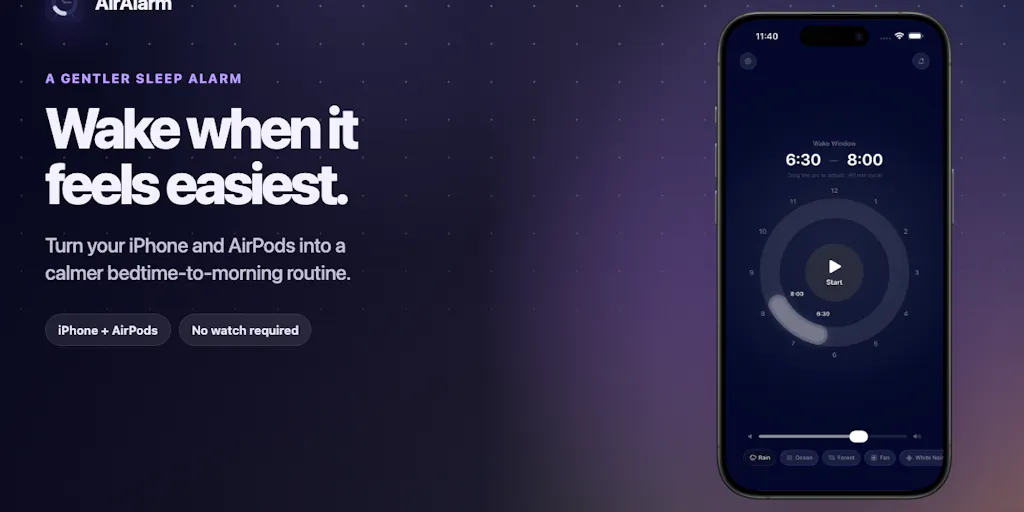
Every once in a while, a product launches that has nothing to do with e-commerce, yet tells you everything about where your own operation is heading. This week, a solo developer named 張詩楓 (Kaede) launched AirAlarm on Product Hunt, a native iOS alarm app that uses your AirPods’ sleep detection to wake you at the optimal point within a window you choose, rather than at an arbitrary minute. It’s not a Shopify app, it’s not an Amazon tool, and it won’t touch your PPC spend. But it’s a masterclass in product philosophy that directly indicts the bloated, account-hungry, data-harvesting SaaS stack most cross-border operators have accepted as normal. For sellers drowning in dashboards that demand more permissions than a border agent, AirAlarm is a reminder that the next competitive edge isn’t another feature — it’s restraint. Let me explain why a sleep app for AirPods users is relevant to your Q4 planning.
The Problem: Your Stack is a Sleep-Deprived Monster
The average cross-border seller doesn’t have a tooling problem; they have a tooling tax problem. We sign up for a Helium 10 subscription to spy on keywords, then a Klaviyo flow to spam buyers, then a Zendesk alternative for support tickets that could be answered by a well-written FAQ. Each tool promises to “save time” but actually consumes it in setup, training, and reconciliation. The real cost isn’t the monthly fee — it’s the cognitive overhead of managing a stack that requires more maintenance than a warehouse robot.
AirAlarm’s thesis is that the best tool is the one that disappears. The maker explicitly states the app was built because they wanted “a gentler alarm without adding another wearable, account, or cloud sleep profile to my night.” Read that again: without adding another account. When is the last time a B2B SaaS vendor said that to you? They want your email, your company size, your revenue band, and often a credit card before you’ve seen a single metric. AirAlarm is native SwiftUI, uses Apple’s system-level AlarmKit, and keeps sleep history on the iPhone. There are no ads, no analytics SDKs, and no required accounts. It’s a product that respects the user’s device as a boundary.
For a cross-border operator, this is a direct challenge to the “more data is better” orthodoxy. You don’t need to track every mouse movement on your PDP. You need to know if the product page converts. You don’t need a “customer data platform” that unifies 14 identities. You need to know if the customer received the right product and whether they’ll buy again. The bloat is a feature for the software companies, not for you.
Why Amazon sellers should care more than Shopify ones
If you sell on Amazon Seller Central, you already live inside a platform that hoards data and dictates terms. You are a tenant, not an owner. Your margin is at the mercy of FBA fee changes and ad auction dynamics. In that environment, every piece of software you bolt on either gives you leverage or adds another dependency. A tool that demands a separate login, a separate API key, and a separate training video is not leverage — it’s a liability. AirAlarm’s appeal is that it does one thing (wake you up better) without asking for anything in return. The equivalent for an Amazon seller would be a repricing tool that didn’t require a monthly subscription but instead took a tiny cut of the upside. Or a review management tool that didn’t store your customer emails on a third-party server. The point is: the best tools are the ones that align incentives with outcomes, not the ones that maximize data collection.
How AirAlarm Differs from the Incumbents
The existing alarm market is split between feature-bloated apps like Sleep Cycle and Alarmy, which offer sleep tracking, smart wake-up, and a hundred other settings that require you to build a sleep profile by logging data for weeks. Then there’s the hardware route — wearables like Oura Ring or Whoop that cost hundreds of dollars and require yet another subscription to interpret your biometrics. AirAlarm sidesteps both by leveraging the hardware you already own: your AirPods.
The core mechanic is simple. You set a “latest time you absolutely can’t sleep past” — a deadline, not a target. The app then uses the bedtime flow — when you fall asleep with your AirPods in and audio playing — to schedule the end of a 90-minute sleep cycle within that window. Instead of the alarm being a cliff you fall off at 6:40 AM, it’s a landing zone where you wake at the moment you’re most likely to be in a light sleep phase. The maker’s response to a commenter nails the value proposition: “You set the deadline and let the app handle the rest.” No more lying in bed doing mental math about how much sleep you’ll get if you fall asleep right now.
This is a fundamentally different approach from the incumbents. Sleep Cycle uses your phone’s accelerometer to detect movement and wakes you in a 30-minute window before your set time. But it requires the phone to be on the mattress, which is a terrible experience if you charge your phone overnight or share a bed. AirAlarm uses AirPods’ sleep detection, which is more accurate and doesn’t require you to sleep with a brick under your pillow. Alarmy, on the other hand, is about forced wakefulness — you have to solve math problems or scan barcodes to turn it off. It’s effective but adversarial. AirAlarm is cooperative — it works with your sleep cycle, not against it.
Where the math breaks
Here’s where my operator brain starts poking holes. The 90-minute sleep cycle assumption is a heuristic, not a law. Sleep cycles vary from 70 to 110 minutes depending on the person, the night, and the amount of alcohol consumed. The app is betting that a fixed 90-minute interval is close enough to catch you in a light phase. For many people, it will be. For others, it will be off by 20 minutes, which is exactly the kind of error that makes you groggy. The maker acknowledges this is a core idea but doesn’t claim it’s personalized — it’s a fixed interval. That’s a reasonable v1, but it’s not a magic bullet.
The other math problem is the platform lock-in. The app only works if you have an iPhone and AirPods. It’s native SwiftUI, and the sleep detection relies on the AirPods feature that pauses audio when you fall asleep. The maker explicitly says there’s no Android equivalent capability accessible to them right now. That’s a huge addressable market left on the table. Android holds roughly 70% of the global smartphone market, and in many cross-border target markets — Germany, India, Brazil — it’s even higher. By building only for the Apple ecosystem, AirAlarm is a niche product for a premium demographic. That might be a deliberate choice for a solo developer, but it limits the product’s ceiling.
What Cross-Border Sellers Can Borrow from AirAlarm
The most transferable lesson isn’t in the sleep science; it’s in the product execution. Here are three things you can steal for your own operation this week.
1. The deadline mindset, not the target mindset. AirAlarm doesn’t ask you to commit to an exact wake time. It asks you to commit to a deadline — the latest you can sleep past — and then optimizes within that window. For a seller, this is the difference between setting a rigid “launch on November 1st” date and setting a “must be live by November 15th” deadline with a flexible launch window. The rigid date creates artificial pressure and forces bad decisions (like shipping half-finished creative). The deadline creates a boundary within which you can optimize for the best moment — whether that’s inventory arrival, ad approval, or a dip in CPC. Apply the deadline mindset to your next product launch and see how much anxiety disappears.
2. Leverage what the customer already owns. AirAlarm’s entire value prop is built on the fact that you already have AirPods and an iPhone. It doesn’t ask you to buy a wearable, sign up for a service, or change your behavior. The equivalent for a DTC brand is to stop building features that require customers to download a separate app or create an account. Use Shopify’s Shop Pay for one-click checkout instead of forcing account creation. Use Klaviyo’s SMS integration to reach customers on a channel they already use, rather than pushing them to a new community platform. The best growth hacks are the ones that remove friction from existing behavior, not add new steps.
3. Privacy as a feature, not a checkbox. AirAlarm’s lack of ads, analytics SDKs, and required accounts isn’t a limitation — it’s a differentiator. In a world where every app wants your data, the one that doesn’t stands out. For cross-border sellers, especially those selling into the EU where GDPR fines are real, privacy isn’t just compliance — it’s a selling point. Put “No account required” on your PDP. Mention that you don’t sell customer data. Use Cookiebot or a similar consent management tool to make your compliance visible. In a market where trust is the scarcest commodity, privacy is a conversion lever you’re probably ignoring.
The tooling stack lesson: Less is more
The AirAlarm philosophy — no account, no cloud profile, no analytics — is the exact opposite of the typical SaaS growth play. Most tools want to be the “system of record” for your business. They want your data locked in, so you can’t leave. AirAlarm keeps everything on-device, which means the user can abandon it at any time without losing anything. That’s a terrifying model for a SaaS company but a liberating one for the user.
For your own stack, ask a brutal question: if this tool disappeared tomorrow, would my business suffer, or would I just lose time? If the answer is “lose time,” you’re fine. If the answer is “lose data I can’t recreate,” you have a dependency problem. Tools like Airtable or Notion are great for this because they let you export everything. But even they require you to build the system. The best tools are the ones that hold your hand, do the work, and then get out of the way — exactly like AirAlarm does.
Where I’m Skeptical: The Solo Developer Ceiling
I’ve been watching Product Hunt launches for years, and the pattern is always the same. A solo developer builds something beautiful, gets a burst of attention, and then either fades away or gets acquired. AirAlarm is a beautiful v1, but it has a ceiling. The lack of Android support is a conscious choice, but it’s also a strategic dead end. The app’s reliance on AirPods’ sleep detection means it’s tied to Apple’s hardware roadmap. If Apple changes the API or deprecates the feature, the app is dead. This is the risk of building on someone else’s platform without a moat.
For cross-border sellers, the lesson is about platform risk. If you’re building your entire business on TikTok Shop or Temu, you’re at the mercy of their algorithm and policy changes. Diversification isn’t just about spreading sales across channels; it’s about building an owned audience through email and SMS that you can reach regardless of what the platforms do. AirAlarm has no such moat — it’s pure platform dependency. Don’t make the same mistake with your traffic.
Another concern: the 90-minute sleep cycle assumption. The maker is a solo developer, and the app is v1. There’s no mention of personalization, machine learning, or adjustment based on your actual sleep data. It’s a fixed interval that works for the average person but not for everyone. For a sleep app, that’s acceptable. For a repricing tool or an inventory forecasting tool, that level of imprecision would be a disaster. If you’re evaluating AI tools for your business, demand that they use your data to personalize, not just apply a generic heuristic. A tool that claims to optimize your ad spend but uses industry averages instead of your actual conversion rates is worse than no tool at all.
The “no account” tradeoff
AirAlarm’s no-account approach is great for privacy but terrible for retention. Without an account, there’s no way to sync settings across devices, no way to recover a lost configuration, and no way for the developer to send you a notification about an update. The maker says they don’t plan to make it account-heavy, which is a noble stance, but it also means the app has no lock-in. Users can abandon it without a second thought.
For your own business, consider the tradeoff. Forcing account creation on your Shopify store will drop conversion rates by 10-20%, but it gives you a direct line to the customer for reorders. The right answer depends on your product. If you sell consumables (coffee, skincare, supplements), an account is worth the friction because it enables subscription. If you sell one-off items (furniture, electronics), the account is just a barrier. AirAlarm is a daily-use app, so it should have an account to enable syncing and personalization. The fact that it doesn’t is a missed opportunity for the developer, even if it’s a win for privacy. Don’t let ideology blind you to the right business model.
What I’d Watch / Test Next
AirAlarm isn’t going to change your P&L, but it’s a signal. Here’s what I’d do this week, as a cross-border operator, to apply its lessons:
Audit your stack for “account bloat.” List every SaaS tool you pay for monthly. For each one, ask: does it require a separate login? Does it store data I can’t export? Does it have analytics SDKs that track my customers? If the answer is yes to any of these, consider whether you can replace it with a simpler tool or a manual process. The goal is to reduce your cognitive load, not just your spend.
Test the “deadline” approach on your next launch. Instead of setting a hard launch date, set a deadline — the latest you can go live — and build a launch window around it. Use that flexibility to optimize for ad costs, inventory arrival, or email list growth. See if the reduced pressure leads to better decisions.
Try a no-account checkout. If you’re on Shopify, enable guest checkout and Shop Pay as the default. Measure the conversion rate difference over a week. If it goes up, you’ve found a friction point you didn’t know you had. If it goes down, you have your answer — but I’d bet on it going up.
Watch the AirAlarm Product Hunt page for the maker’s responses to feedback. The comments reveal what users actually want — and whether the maker is listening. It’s a live case study in community-driven iteration, and you can apply the same listening discipline to your own product reviews and support tickets.
The takeaway isn’t to copy AirAlarm. It’s to recognize that the next wave of competitive advantage in cross-border e-commerce won’t come from another feature or another integration. It will come from building tools that respect the user, do one thing well, and get out of the way. If your stack feels heavy, that’s not a sign you need more tools — it’s a sign you need fewer, better ones.


