Why This Matters to a Cross-Border Seller Before You Read Another Word
If you’ve tried to make an AI agent do anything genuinely useful for your e-commerce operations—like monitor competitor pricing across five marketplaces, scrape review sentiment from TikTok Shop, or reconcile ad spend from Amazon and Meta into a single dashboard—you’ve hit the same wall I hit last year. The agent reasons well. It can draft a listing, generate A+ content, even suggest a PPC bid adjustment. But the moment it needs real-time data from the live internet, you’re suddenly wrangling six different API keys, three authentication schemes, and a pile of bills from providers who each have their own failure modes. The plumbing breaks your workflow before the agent ever gets to work.
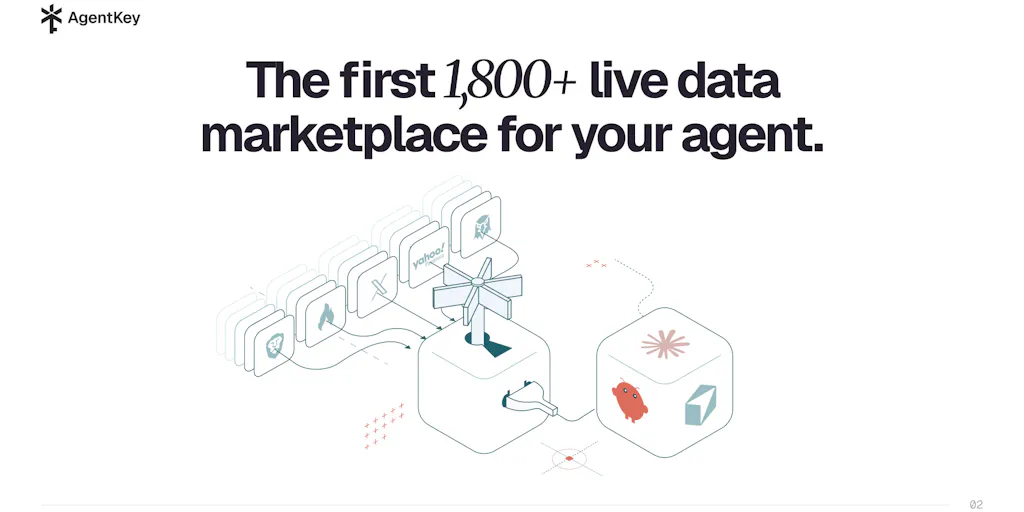
That’s why AgentKey caught my eye on Product Hunt this week. It promises to give agents “eyes” by bundling search, scraping, social, finance, and travel data behind a single account and API key—with automatic failover, no keys to manage, and a marketplace of capabilities that grows as more providers are vetted. For any operator who’s built an agent that lives inside a sandbox of yesterday’s data, this sounds like the missing abstraction layer. But as with any marketplace for live data, the real test isn’t how many tools you can list—it’s whether the agent picks the right one at the right time, and whether you can trust the result.
The Real Problem – And Why It’s Worse for Cross-Border Sellers Than for a General Developer
Every e-commerce operator I know who’s tried to automate a multichannel workflow has ended up with a spreadsheet of API credentials that reads like a hostage list. SerpAPI for Google Shopping results, an unofficial Amazon Product Advertising API wrapper for pricing, a TikTok influencer scraper that breaks every three weeks, a currency exchange endpoint, a shipping rate calculator—each one requires its own rate limiting, error handling, and billing cycle. The bottleneck isn’t the agent’s reasoning capability; it’s the sheer overhead of wiring the agent to the web.
AgentKey solves that overhead in a way that’s particularly relevant for sellers who aren’t full-time developers. Instead of juggling a dozen providers, you install one plugin (it plugs into 20+ agents including Claude, Codex, and Cursor), and your agent gets access to a curated marketplace of tools—everything from everyday web scraping and social media data to finance and crypto feeds. One account, one bill, and the auto-failover feature means if a data provider goes down, the agent can fall back to another source without you having to rewrite a single line. The maker, Mogu (founder of Chainbase), explicitly frames this as the solution to “agents that can reason but can’t see the live internet.”
For a cross-border seller, that abstraction is a lifeline. Imagine an agent that can simultaneously check the current Amazon Best Seller Rank for a product in the US market, scrape the latest trending hashtags on TikTok Shop in the UK, pull the USD/GBP exchange rate, and fetch a competitor’s product description from an EU marketplace—all without you patching together five separate integrations. That’s the promise.
But here’s where the e-commerce lens forces me to slow down. The marketplace’s current tiers include “professional data” like finance and crypto, but what about the specific data sources sellers actually need? I don’t see a dedicated Amazon API endpoint, a TikTok Shop scraper, or a real-time Google Shopping feed. The catalog is curated rather than open, which is smart for trust, but it means the data that would make this genuinely transformative for a seller might not be there yet. The makers acknowledged in the comments that they’re starting with “established vendors” and vetting every provider before adding them. That’s responsible, but it also means the “marketplace of capabilities” is only as useful as the providers who bother to integrate.
How AgentKey Differs from the Status Quo
The existing alternatives for giving agents live data are either (a) wiring raw APIs yourself, (b) using a service like RapidAPI to discover endpoints but still managing keys individually, or © building a custom scraping pipeline with tools like Scrapy or Playwright. AgentKey collapses that spectrum into a single MCP (Model Context Protocol) integration. The key architectural difference I see is the token optimization: a comment from maker lxcong reveals that the typical tool discovery pipeline goes from “roughly 35,000 tokens to about 1,500” by using a retrieval layer instead of dumping every endpoint definition into the agent’s context. That matters because token cost is a real constraint when you’re running agents at scale, especially if you’re using Claude or GPT-4 for dozens of product research queries a day.
Another differentiator is the hosted proxy model. Every data call routes through AgentKey’s servers—not your own infrastructure. That enables the pooled billing, quality-of-service shaping, and automatic failover the product markets. But as commenter Noctis Leonard pointed out, it also means your agent’s query parameters pass through a third party. For sellers who treat pricing data and competitive intelligence as trade secrets, that’s a non-trivial trust consideration. The makers confirmed that local mode with your own upstream keys is not on the roadmap, which means you’re committing to a hosted intermediary. For a small shop that’s fine; for a DTC brand doing millions in revenue, that’s a security conversation you need to have with your team.
Why Amazon Sellers Should Care More Than Shopify Ones
If you sell on Shopify, most of your valuable data lives inside your own ecosystem—your store analytics, customer lifetime value, email lists. You can already pull that data into an agent via Shopify’s Admin API with a single key. The live-internet data you need (competitor pricing, trending products, ad benchmarks) is important but not operationally critical on a minute-by-minute basis.
Amazon sellers live in a different reality. Your entire business depends on data sourced from outside your own account: Buy Box pricing, keyword rankings, review velocity, inventory levels of competitors, PPC cost-per-click trends across the marketplace. That data changes hourly, and none of it comes through a single clean API. Amazon’s own API is famously restrictive for third-party access. Most sellers rely on a patchwork of tools like Helium 10, SellerSprite, and Keepa—each with its own API, rate limits, and cost structure. An abstraction like AgentKey, if it added an Amazon data provider layer, could finally give Amazon sellers a unified data pipe into their agents. The current marketplace includes “business data” but doesn’t specify marketplace-specific sources. The makers should prioritize a curated Amazon data provider next.
What Cross-Border Sellers Can Borrow from the Concept
Even if AgentKey doesn’t yet have the data sources you need, the architectural thinking behind it is directly applicable to how you build your own agent tooling. Three lessons stand out.
First, treat tool discovery as a retrieval problem, not a context dump. The token math the makers shared—going from 35,000 to 1,500 tokens—is a concrete pattern you can replicate. When you wire an agent to multiple data sources, don’t dump every endpoint’s full schema into the system prompt. Instead, build a lightweight retrieval step: the agent sends a natural-language query, a retriever returns the top 3–5 relevant tools with short descriptions, and only then does the agent call the full schema. This keeps your agent’s context lean and reduces cost.
Second, build provenance into the call. AgentKey ensures the provider name is literally in the tool name, so the agent knows which source answered. For any e-commerce agent that touches pricing or inventory data, provenance is not a nice-to-have—it’s an audit requirement. If your agent makes a bad decision based on a stale or wrong data point, you need to trace which source to blame. The makers show that they log every call to a console and plan to add explicit per-call fallback markers. You can do the same in your own system by tagging every API response with the provider ID and timestamp.
Third, design for auto-failover but monitor for silent accuracy shifts. The automatic fallback to an alternative provider is a great feature for uptime, but as commenter David noted, if the agent swaps sources mid-workflow without visibility, data quality can silently degrade. If you’re building a multi-provider agent stack, make the fallback visible—either in the agent’s output or in a log—so you can sanity-check the results. For high-stakes decisions like adjusting a PPC bid based on a competitor’s price, you might even want the agent to corroborate with a second source before acting.
Where the Math Breaks
The token optimization is real, but it only helps if the retrieval model actually picks the right tool. As commenter Uddipta Mahanta pointed out, “the retrieval model picks the wrong endpoint for an ambiguous request” can lead to a silent bad result downstream. The makers admit this is their weakest point: “Silent bad picks are the hard case… The feedback part is where the real work is, and it’s barely started.” For a seller using an agent to decide which product to restock or how much to bid on a keyword, a wrong pick that returns a result (not a crash) is dangerous because it looks normal. The agent might confidently act on bad data.
The current mitigation is that the agent can re-query with better phrasing, and the transcript shows the shortlist. But in a production e-commerce workflow, you can’t have a human watching every agent call. Until the makers productize the feedback loop—where wrong picks are flagged and the learning feeds back into future retrieval—the system will have a blind spot. For low-stakes tasks like content generation, that’s acceptable. For pricing or restocking decisions, it’s a risk.
Where My Judgment Says It Falls Short
I’ll give the makers credit for being refreshingly honest in the comments. They didn’t claim an accuracy guarantee, they admitted the feedback loop is “barely started,” and they explained why the marketplace is curated rather than open. That transparency earns trust. But from a cross-border seller’s perspective, I see three gaps that need closing before I’d build a critical workflow on top of AgentKey.
1. No local mode. Every data call passes through AgentKey’s proxy. For sellers in jurisdictions with strict data residency requirements (GDPR in Europe, PIPL in China, PIPA in South Korea), that’s a compliance headache. If you operate a DTC brand selling into the EU, you might be legally required to ensure personal data doesn’t leave the region. A hosted proxy that routes through a US server means you can’t control where the data lands. The makers said local mode isn’t planned, so this is a hard blocker for some operators.
2. Limited e-commerce-specific data sources. The marketplace covers search, social, finance, crypto, weather, and travel. Where is the Amazon data? The eBay marketplace data? The TikTok Shop analytics? The Google Shopping feed? These are the live internet data points that actually drive e-commerce decisions. The makers are starting with “everyday tools” and “professional data” from established vendors, but until a dedicated e-commerce data provider joins the marketplace, the utility for sellers remains theoretical. I’d want to see a partnership with a tool like Keepa or Helium 10 integrated as a provider.
3. No accuracy guarantee for data values. This is the hardest problem. AgentKey can guarantee uptime and fallback, but it cannot guarantee that the raw data returned by a provider is correct. The makers are honest about this, but for a seller who needs to know if a competitor’s price is truly $24.99 or if a scraping artifact returned an old cached value, that uncertainty is a dealbreaker. The makers suggest an ex ante defense: use a second source for high-stakes queries. That works, but it doubles cost and complexity. For the product to be a true platform for e-commerce agents, the marketplace needs to evolve from curated listings to verified data feeds with freshness guarantees.
What I’d Watch / Test Next
This isn’t a product I’d bet a quarter of my monthly ad budget on today, but it’s worth running a tight experiment. Here’s what I’d do this week:
- Sign up for the free tier (no card required) and connect it to a Claude project or a Cursor agent. Start with a low-stakes task: “Monitor the current price of [my top-selling SKU] on Amazon and alert me if it drops below $X.” Use the marketplace’s search and scraping tools. Run the query hourly for two days.
- Audit the provenance log. Check the console log to see which provider served the price. Then verify the price manually on Amazon. If the numbers match, great. If not, note whether the agent silently accepted the wrong data or flagged the discrepancy. This will tell you how useful the provenance feature actually is.
- Test the failover. Pick a time when one provider is likely to rate-limit or fail (e.g., during a known scrape window). Trigger a query and see if the agent automatically switches to an alternative source without error. Confirm that the fallback is logged and visible.
- Evaluate latency. For any real-time use case like Buy Box monitoring or PPC bid adjustment, latency matters. Measure the round-trip time from agent query to result. If it’s more than 2–3 seconds, the hosted proxy adds too much overhead for time-sensitive decisions.
If those tests pass, I’d next look for the data sources that matter most to my operation—Amazon product data, TikTok Shop trends, Google Shopping results—and check whether they’re available or being added. If they are, this could become a genuinely useful layer in the stack. If not, the concept is right, but the execution is still too far from the realities of cross-border e-commerce.
Either way, the conversation on that Product Hunt page—especially the back-and-forth about silent wrong picks and provenance—is worth a read for any seller building agent workflows. The makers are thinking about the right problems. Now they need to solve them for the data we actually use.


