The 3AM Test: What an AI On-Call Engineer Teaches Cross-Border Operators About Trusting Automation
Cross-border sellers spend their days automating everything that can be automated — repricing, ad bidding, review requests, inventory syncs, returns routing. Then something breaks at 2 a.m. in a timezone where nobody on the team is awake, and the automation stack that was supposed to run the business turns into a black box. That is the real reason I read the 3AM Super Intelligence launch closely, even though it is not an e-commerce tool. The team behind 3AM is selling an AI on-call engineer for infrastructure you “can’t rewrite,” and its design choices — proof over confidence, shadow mode before action, human approval before any change — are the exact guardrails every seller should demand from the next generation of AI ops tooling they bolt onto Shopify, Seller Central, and their warehouse stack.
What 3AM Is Actually Selling (And Why It’s Not a Chatbot)
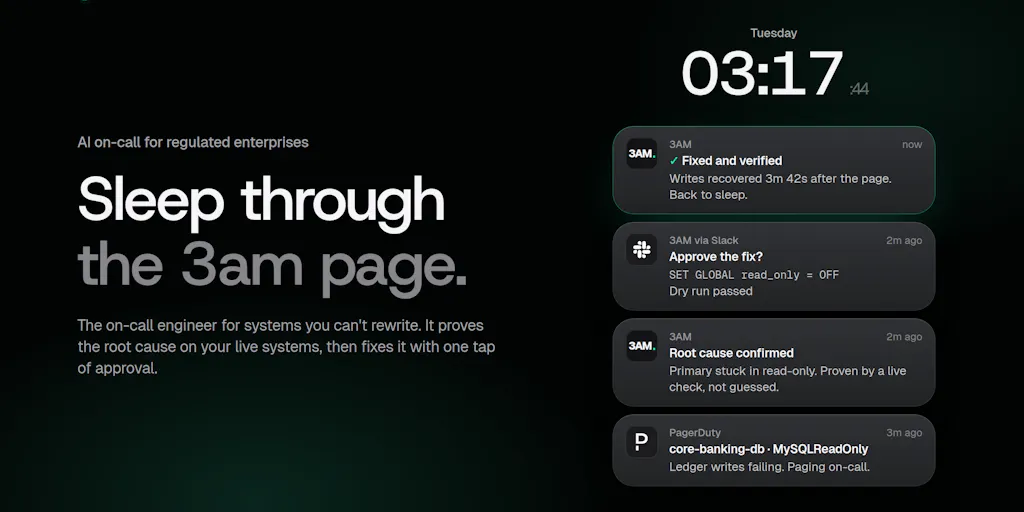
Strip away the launch-day framing and 3AM is an incident-response agent that runs inside your own network. The maker, Siddhesh Kulthe, frames the product around three constraints, and each one maps to a frustration operators will recognize.
First, proof over guesses. The pitch is explicit: nobody runs a fix on production at 3am because a chatbot sounded confident, so 3AM only names a root cause once a live check against your systems proves it — and when it can’t prove one, it says so and hands over what it found. That is a fundamentally different contract from the “here’s a plausible answer” model most AI assistants ship with.
Second, data stays inside. Banks, insurers, and telcos can’t ship production data to someone else’s cloud, so 3AM runs inside your network with no inbound ports, works fully air-gapped, and the only thing that reaches the vendor is a signed licence check. Third, humans stay in charge: every fix is rehearsed with a dry run, then waits for approval in Slack, Symphony, PagerDuty, xMatters, or email. It starts in shadow mode — watching and proposing but changing nothing — and granting more autonomy requires two approvers. Every step lands on a hash-chained audit log auditors can verify.
The credibility signal I care about most is how they test it: breaking a real open-source core banking system — 244,000 lines of ten-year-old Java — on purpose, in 67 different ways, with zero harmful actions as a release gate rather than a target. The first 90 days are free, and 3AM is explicitly in open alpha.
The comment thread is the real product spec
The most useful part of the launch page isn’t the maker’s pitch — it’s the pushback. One commenter, Bengeekly, asks the obvious question: how do I know it won’t create more bugs than it solves? The answer — shadow mode, evidence, human approval, then a recheck that the fix worked — is the right shape, but it’s also a promise, not a proof.
The sharper thread comes from Saikat Kumar, who describes a production freeze where every dashboard said the app was hung, but the real cause was a schema change at startup quietly waiting on a lock behind one long-running query. Would 3AM find “a waiter, not an error”? The maker’s reply is refreshingly honest: 3AM can inspect live database sessions and lock waiters, but killing a blocking query is a different story — it can roll back a transaction, so it wants evidence and approval first. Kumar’s follow-up is the best line on the page: what actually fixed it for his team was a short lock timeout on startup migrations, so the deploy fails fast and loudly instead of hanging the app — and he suggests 3AM should recommend that prevention step after it finds the blocker. That exchange tells you more about the product’s maturity than any launch copy.
Where This Fits in the Seller’s Tooling Stack — and Where It Doesn’t
Here’s my honest read: 3AM is built for regulated enterprises with production infrastructure, not for a DTC brand running Shopify plus a handful of apps. A mid-size seller does not have a core banking system to break; they have a theme, a checkout, a fulfillment integration, and a pile of SaaS. So the direct product is not for most readers of this blog.
But the pattern is. Cross-border operators are about to be sold a wave of AI agents that “manage” their Amazon PPC, their Helium 10 research workflows, their Klaviyo flows, their TikTok Shop listings, their Temu pricing, their returns. The vendors will demo confidence. The question every operator should ask — the 3AM question — is: does this thing prove its claims against my live data before it acts, and does it ask me before it changes anything?
Why Amazon sellers should care more than Shopify ones
A Shopify merchant can usually roll back a bad theme deploy in minutes. An Amazon FBA brand owner cannot roll back a listing hijack, a suppressed buy box, or a mispriced promotion that burned through inventory in a night. The blast radius of an autonomous agent touching Amazon Seller Central is asymmetric in a way that makes 3AM’s “shadow mode + two approvers” design feel less like enterprise caution and more like basic survival. If a tool wants write access to your ad campaigns or your pricing, it should earn that access the way 3AM does: watch first, propose second, act only with sign-off, then verify the fix worked.
Where the math breaks
3AM runs inside your network with no inbound ports and air-gapped support. That’s the right architecture for a bank. For a seller, the equivalent discipline is simpler and cheaper: API keys scoped to read-only until you trust the tool, staging environments for anything that touches checkout, and an approval step — even a Slack emoji — before an agent pushes a price change or a listing edit. The launch page’s “first 90 days are on us” offer is a reminder that even a vendor selling proof wants you to run it in shadow mode before you pay. Take the hint.
What Cross-Border Operators Should Borrow From This Launch
Three things, and none of them require buying 3AM.
One: demand live verification, not confidence. The phrase “names a root cause only once a live check against your systems proves it” should be your filter for every AI tool in your stack. When a repricing tool tells you it found the optimal price, ask what it checked against. When an ad tool claims a campaign is underperforming, ask whether it looked at your actual search-term report or just the dashboard summary.
Two: insist on shadow mode. 3AM starts by watching and proposing, changing nothing. Any new automation — a returns-routing rule, a TikTok Shop listing agent, a Temu price sync — should run in observe-only mode for at least two weeks before it gets write access. You will learn more from its proposals than from its actions.
Three: make the audit log non-negotiable. The hash-chained log is overkill for a seller, but the principle isn’t: every automated change should be attributable, timestamped, and reversible. If a tool can’t tell you what it changed, when, and why, it doesn’t belong near your money.
The uncomfortable part
The launch page is honest that 3AM is in open alpha, and the comment thread shows a product still learning its own boundaries — the maker concedes that killing a blocking query is “a different story” and that prevention suggestions are a gap a user had to point out. That’s fine for an alpha. It’s not fine for the AI agents already being marketed to sellers as “set it and forget it.” The gap between “can inspect” and “can safely act” is exactly where operators get burned, and 3AM’s willingness to say so out loud is the most trust-building thing on the page.
What I’d Watch / Test Next
This week, do a 3AM-style audit of one automation you already run. Pick your repricing tool or your ad-bidding agent, and answer three questions in writing: Does it verify against live data before acting, or does it act on a model’s guess? Is there a shadow or approval step, or does it have standing write access? Can you pull a log of every change it made in the last 30 days, with timestamps and reasons? If any answer is “no,” downgrade that tool to read-only until it earns back trust.
Then watch 3AM’s next few releases for one specific thing: whether the prevention-suggestion gap Kumar flagged gets closed. An agent that not only finds the blocker but recommends the fix — a lock timeout, a scoped API key, a staging gate — is the version of this category worth paying for. Until then, treat every “AI ops” pitch aimed at sellers the way 3AM treats production: prove it first, then let it touch anything.


